Notice:
The advice given on this site is based upon individual or quoted experience, yours may differ.
The Officers, Staff and members of this site only provide information based upon the concept that anyone utilizing this information does so at their own risk and holds harmless all contributors to this site.
I'm new to the Cat 25 and I am wondering about the configuration of the bow life lines. Why in the world do they angle down to the deck just aft of the bow pulpit? It would seem to me that this is where you need the life lines the most when up forward changing the jib! Has anybody ever changed this arrangement? I can understand that you want a strong attachment, at deck level, for the end of the life line. But certainly there has got to be a better idea than this. I am considering modifying this arrangement by drilling and sleeving a hole through the aft-most bow pulpit stanchion and then angling down to the line attachment at the base of the forward pulpit stanchion. Any comments on why this might not be a good idea?
Steve Krenz `Elan 1978 SR/SK #482 Santa Fe, New Mexico
The foot of the jib needs to sweep across that space each time you tack or jibe, so the lifelines are lowered there to stay out of the way. Are you thinking of raising the lifeline there to be horizontal?
The reason for it is as Frank and John have said. Yes it is disconserting when yor are heeld hard over and bouncing around in chop but you'll get used to it (maybe). In the meantime keep your legs bent and your feet wide apart, get to the the bow pulpit as fast as you can and wedge yourself into it while working on the head sail. Oh Yeah,wear a harness teathered to a Jack line. And wearing a pfd is also a good idea and it keeps the coasties happy. One more thing - Have Fun, that's what the C-25 is all about.
<blockquote id="quote"><font size="1" face="Verdana, Arial, Helvetica" id="quote">quote:<hr height="1" noshade id="quote">get to the the bow pulpit as fast as you can and wedge yourself into it while working on the head sail. <hr height="1" noshade id="quote"></font id="quote"></blockquote id="quote">
This is why you have children (or at the very least an Admiral) you send them forward when its too dangerous to go forward yourself.
The (serious) advice I have is relevent to any modifications you might be thinking of - wait til you've sailed the boat for a season. I had a list as long as my arm when I first got my boat and someone here told me to wait a season. It was excellent advice.
Exactly! I just did not want to be the one to say it. Several years ago I finally figured out that pulling up on them as you walk puts down force on your feet and actually helps in rough weather, but the idea that you might fall against them and they would help keep you on deck is wishful thinking.
Welcome Skrenz, I think Catalina had the same thoughts. By 1989 the life lines were made to attach to the bow pulpit. It's a bit safer although as Dave Bristle says, don't EVEN think you can put your weight into one, just use it to steady yourself. I've attached a short line to the bottom of my jib so it's up almost a foot and doesn't interact with the lines. It's great and allows better vision forward from the cockpit.
<blockquote id="quote"><font size="1" face="Verdana, Arial, Helvetica" id="quote">quote:<hr height="1" noshade id="quote"><i>Originally posted by Frank Hopper</i> <br />...I finally figured out that pulling up on them as you walk puts down force on your feet and actually helps in rough weather...<hr height="1" noshade id="quote"></font id="quote"></blockquote id="quote">In rough weather, I recommend the "butt-on-the-cabintop" method of going forward. Even better: roller furling.
Thanks for all the very useful input. I have to say that I did not think about the sweep of the jib. This question arose because, being on the hard and getting ready for summer, I noted that I needed to replace my life lines.
I agree that a jack line and tether is the way to go. BTW, does anyone have a recommendation on how and where to install a jack line?
Interesting. So if I understand this correctly, on my boat I have lifelines that go all the way around. I have a roller furling on it. So when I'm tacking I can expect the sail to hit the lifelines? A normal situation? Sorry for my ignorance.
<blockquote id="quote"><font size="1" face="Verdana, Arial, Helvetica" id="quote">quote:<hr height="1" noshade id="quote"><i>Originally posted by skrenz</i> <br /> BTW, does anyone have a recommendation on how and where to install a jack line? <hr height="1" noshade id="quote"></font id="quote"></blockquote id="quote"> See this link to an earlier thread discussing different ways to install jack lines .http://www.catalina-capri-25s.org/forum/topic.asp?ARCHIVE=true& TOPIC_ID=9899For a quick easy jack line I sometimes use a large loop (2 or 3 feet)of line around the base of the mast.(tied with a bowline knot locked with a couple of half hiches for good measuer)and clip my harness to that as I exit the cockpit to walk forward.
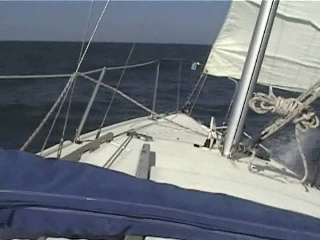
On many boats, You will often see a discolored line on foresails where they come into contact with lifeline or bow pulpit. On our boats, sail contact with the bow pulput is common when on a run and often while sailing to windward. As previously described in this thread, the foresail will usually occupy the gap on the lifeline. This is a picture of my boat sailing (more or less) close hauled. If you look closely you can see where the foot of the foresail crosses over the lowered part of the lifeline - and you can see the bow pulpit silouhetted through the sail. (this is a light weight 100% jib)
<blockquote id="quote"><font size="1" face="Verdana, Arial, Helvetica" id="quote">quote:<hr height="1" noshade id="quote">So when I'm tacking I can expect the sail to hit the lifelines?<hr height="1" noshade id="quote"></font id="quote"></blockquote id="quote"> Yes, and depending on the size of your sail, it will probably make contact with shrouds. Your jib sheets will hang over the lifeline - also visible in my picture above.
<blockquote id="quote"><font size="1" face="Verdana, Arial, Helvetica" id="quote">quote:<hr height="1" noshade id="quote"><i>Originally posted by Oksky</i> <br />...So when I'm tacking I can expect the sail to hit the lifelines? A normal situation?...<hr height="1" noshade id="quote"></font id="quote"></blockquote id="quote">Mike: The sail will pull over the lifelines on a tack, without any issues. Now and then some of us get the knot on the clew (the eye where the sheets attach) stuck on a shroud while tacking, momentarily backwinding the jib. Generally you can shake it off by pulling on the sheet that's hung up. There are a couple of remedies to that if you experience the problem frequently...
Don't be too worried about this stuff--the designers generally knew what they were doing, and the boat sails well as-is. Boats with lifelines as Steve was expecting often sail with the jib bunched up over the lifeline and putting considerable pressure on it--not an ideal configuration.
I have hank on sails and wanted netting up foreward to keep sails on board when changing. I needed a connection at the pulpit to do that. You can get a "Pulpit Anchor 1 in. rail" from Hamilton Marine which you can fasten to the pulpit without drilling any holes. That is the way to go if you want to move the lifeline up or attach netting. I also use them to fasten the halyard end when changing the foresail.
Notice: The advice given on this site is based upon individual or quoted experience, yours may differ. The Officers, Staff and members of this site only provide information based upon the concept that anyone utilizing this information does so at their own risk and holds harmless all contributors to this site.