Notice:
The advice given on this site is based upon individual or quoted experience, yours may differ.
The Officers, Staff and members of this site only provide information based upon the concept that anyone utilizing this information does so at their own risk and holds harmless all contributors to this site.
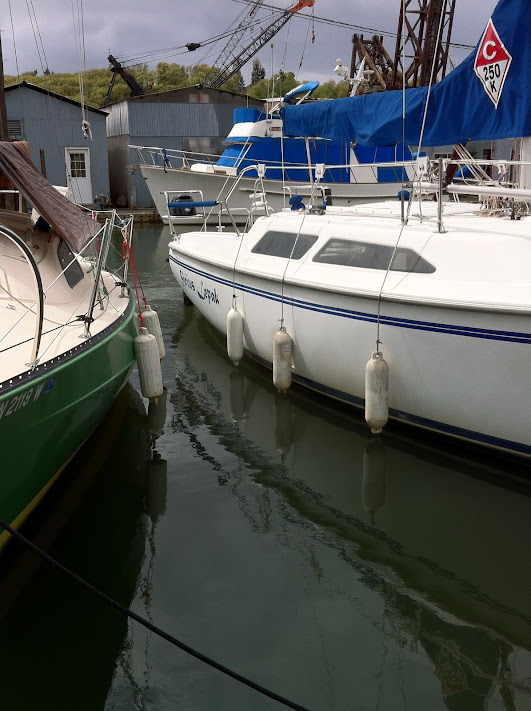
I know this is probably old news, but I read recently that a MCME was good for cleaning up dirty fenders, so I picked some up this week and gave them a try while I was letting my outboard run. Can you guess which fender I cleaned?
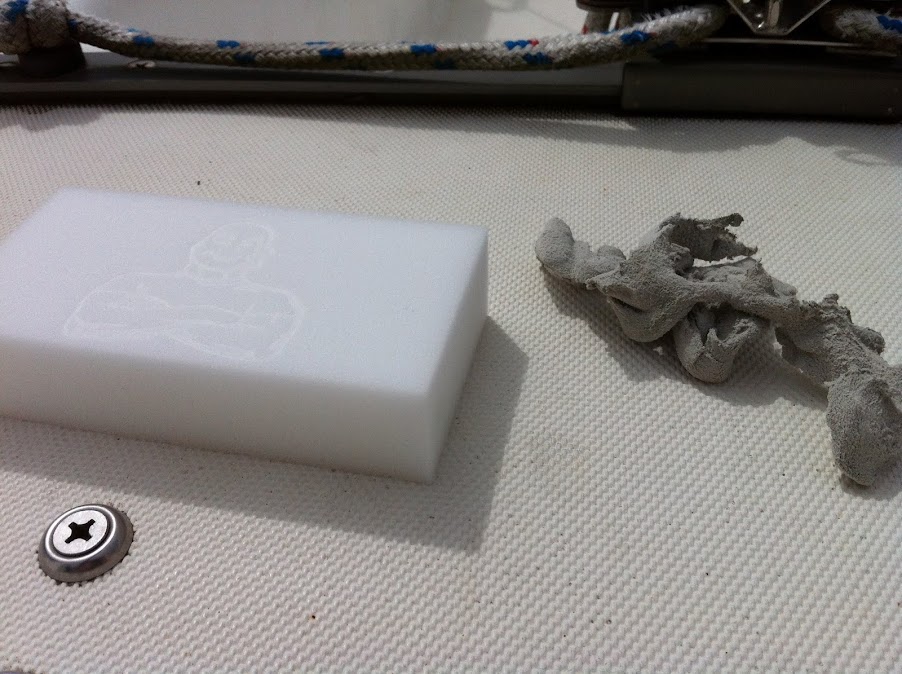
They don't last very long, but they're stunningly effective on all kinds of boat grime. The little black specks that seem to accumulate? Gone. Rub rail? Like new. Gelcoat a bit grimy? Nuh-uh. A-mazing. However, you'll need a few of them, because after about 15 minutes, this is what they look like:
Lowe's had a "big" pack of them for around $7, I'll be picking up another box of them. I have three left from the original box, and I have plans for them.
David C-250 Mainsheet Editor
Sirius Lepak 1997 C-250 WK TR #271 --Seattle area Port Captain --
Odd product IMHO. Works great on some applications with limited effectiveness on others. May be better on a smooth surface like a fender but disintegrates on, say, nonskid. I keep a small stash on hand . . .
<blockquote id="quote"><font size="1" face="Verdana, Arial, Helvetica" id="quote">quote:<hr height="1" noshade id="quote">There was a write up about them in Practical Sailor in the last couple of years.
Your review is more positive.<hr height="1" noshade id="quote"></font id="quote"></blockquote id="quote">
Do you have a link, or remember the gist of it? I was very impressed with how well they cleaned lots of different things.
<blockquote id="quote"><font size="1" face="Verdana, Arial, Helvetica" id="quote">quote:<hr height="1" noshade id="quote">Odd product IMHO. Works great on some applications with limited effectiveness on others. May be better on a smooth surface like a fender but disintegrates on, say, nonskid. I keep a small stash on hand . . .<hr height="1" noshade id="quote"></font id="quote"></blockquote id="quote">
They certainly don't last long, and trying it on non-skid was what led to the destruction you see above. However, like you said, on flat surfaces, it just almost wipes stuff away, a bit of rubbing, and then a rinse with a microfiber towel, and the surface is just clean-clean.
I remember the first P/S review as very positive, to the point of suggesting that every boat should have a few on board. On a second review they gave the nod to another brand that had a scrubber on one side and was slightly larger. MCME now has one with a scrubber side for those so inclined. I have stayed with the original. A brush is the only thing that can clean non-skid without shredding, and I'm very impressed with Starbrite Non-Skid cleaner
Might be great for flat, smooth surface...ie fenders or stainless (check package for stainless). DO NOT use on painted bedroom walls to remove normal teen-ager marks/scuffs. It did remove the marks ...but it also removed the semi-gloss of the paint.
<blockquote id="quote"><font size="1" face="Verdana, Arial, Helvetica" id="quote">quote:<hr height="1" noshade id="quote"><i>Originally posted by binky</i> <br />Might be great for flat, smooth surface...ie fenders or stainless (check package for stainless). DO NOT use on painted bedroom walls to remove normal teen-ager marks/scuffs. It did remove the marks ...but it also removed the semi-gloss of the paint.
<blockquote id="quote"><font size="1" face="Verdana, Arial, Helvetica" id="quote">quote:<hr height="1" noshade id="quote"><i>Originally posted by Dave5041</i> <br />A brush is the only thing that can clean non-skid without shredding, and I'm very impressed with Starbrite Non-Skid cleaner <hr height="1" noshade id="quote"></font id="quote"></blockquote id="quote"> I have found that using a big sponge with Bab-O Gel cleaner (which contains bleach) does a great job of cleaning the non-skid with very little effort. I don't like rinsing bleach off the boat and into the water, so I limit my use of this stuff to once a year.
And the sponge comes out of this in perfect shape!
<blockquote id="quote"><font size="1" face="Verdana, Arial, Helvetica" id="quote">quote:<hr height="1" noshade id="quote"><i>Originally posted by Dave5041</i> <br />A brush is the only thing that can clean non-skid without shredding, and I'm very impressed with Starbrite Non-Skid cleaner <hr height="1" noshade id="quote"></font id="quote"></blockquote id="quote"> I have found that using a big sponge with Bab-O Gel cleaner (which contains bleach) does a great job of cleaning the non-skid with very little effort. I don't like rinsing bleach off the boat and into the water, so I limit my use of this stuff to once a year.
And the sponge comes out of this in perfect shape!
<blockquote id="quote"><font size="1" face="Verdana, Arial, Helvetica" id="quote">quote:<hr height="1" noshade id="quote"> I don't like rinsing bleach off the boat and into the water, so I limit my use of this stuff to once a year. <hr height="1" noshade id="quote"></font id="quote"></blockquote id="quote">
I do commend you John on trying to be Green but think about how many millions of gal. of chlorinated treated water is pumped back into the water from water treatment plants every day. Makes your effort look like one raindrop in a thunderstorm.
<blockquote id="quote"><font size="1" face="Verdana, Arial, Helvetica" id="quote">quote:<hr height="1" noshade id="quote"><i>Originally posted by islander</i> <br /><blockquote id="quote"><font size="1" face="Verdana, Arial, Helvetica" id="quote">quote:<hr height="1" noshade id="quote"> I don't like rinsing bleach off the boat and into the water, so I limit my use of this stuff to once a year. <hr height="1" noshade id="quote"></font id="quote"></blockquote id="quote">
I do commend you John on trying to be Green but think about how many millions of gal. of chlorinated treated water is pumped back into the water from water treatment plants every day. Makes your effort look like one raindrop in a thunderstorm. <hr height="1" noshade id="quote"></font id="quote"></blockquote id="quote"> And IIRC, sunlight (UV) does a pretty good job of decomposing the hypochlorite to harmless chloride. Just ask anyone with a swimming pool.
Notice: The advice given on this site is based upon individual or quoted experience, yours may differ. The Officers, Staff and members of this site only provide information based upon the concept that anyone utilizing this information does so at their own risk and holds harmless all contributors to this site.