Notice:
The advice given on this site is based upon individual or quoted experience, yours may differ.
The Officers, Staff and members of this site only provide information based upon the concept that anyone utilizing this information does so at their own risk and holds harmless all contributors to this site.
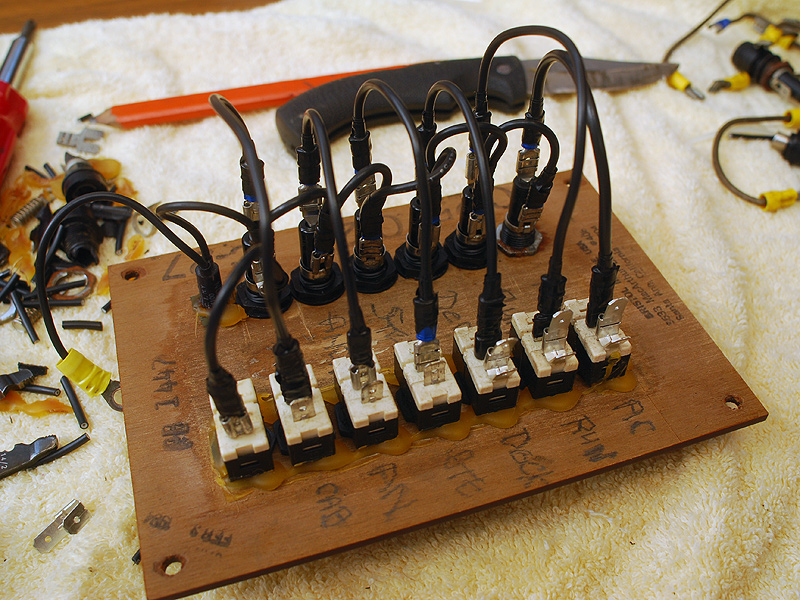
Panel ( main switch, to jumpered to fuses, to each circuit switches )
to cigarette plug in power.
Ground:
Cigarette plug to ground buss bar to battery.
I plug in the lighter power plug for my iphone and the power cuts off.. everything. no power shown on the panel light or the meter wired in parallel. Wait 2 minutes it comes back after the plug has been removed.
I check the slow blow fuse in the panel.. looks good.
Repeat... same thing happens???
I have my meter and I find a short in the ( really crappy iphone power plug ) ones side apparently goes to the light on it and that side had the short... one side of the two prongs on either side is shorting ( continuity ) to the ground on the back. ( or vica versa depending on how they wire those things. )
SO>>>>>>
I would have expected the panel slow blow ( 3 amp I think ) to blow first... What the hell?? I got a self ressetting fuse in there somewhere???
I know the 100 amp is supposto be crap, I've heard they blow badly and slowly.. The 30 amps are new to me and a new product.. and even the 3-5 amp slow blows are a relatively new product to me but they usually just blow don't they??
I know nothing about the MAXI fuses and I gotta look at them.. If they are resetting then it worked really well.. out quick and back after a few minutes...
I played with the switches excessively each time as I expected using them cleans them, and of course every switch I used is new - except - the fuse holder on the panel for the accessory circuit is the only one I did not replace and is an old fuse holder.
Ray in Atlanta, Ga. "Lee Key" '84 Catalina 25 Standard Rig / Fin Keel
Back in "Ought-Six" when I worked in electronic countermeasure in the USN, we halfway believed in gremlins hiding in the circuits that periodically popped out to do mischief.
Dave B. aboard Pearl 1982 TR/SK/Trad. #3399 Lake Erie/Florida Panhandle
Back in "Ought-Six" when I worked in electronic countermeasure in the USN, we halfway believed in gremlins hiding in the circuits that periodically popped out to do mischief.
Halfway??? I fully believe in boat gremlins, they attack me all of the time. I did ask if a few would move on to a boat somewhere else...like Georgia
Me thinks that's funky china fuse...bypass with a nail and test one more time
Btw. why do you have such huge RED positive cable from the battery. but only so thin BLACK negative cable running from the battery? They both should be the same diameter. Anyway should not cause such issues.
Dalpol Phobos 21, 2013, Sole Mio, hull #27, current adventures - We sail Phobos 21
PO of Catalina C25, 1978, High Anxiety, hull #701, SR, FK, L-dinette, inboard diesel Volvo Penta MD2010C w/saildrive - more info
...Current that leaves the battery returns to the battery at lower potential.


Lower potential but same amps, so same voltage drop per length, and same heat buildup - therefore same gauge wire should be needed to avoid melting the insulation even at lower potential.
Rick S., Swarthmore, PA PO of Take Five, 1998 Catalina 250WK #348 (relocated to Baltimore's Inner Harbor) New owner of 2001 Catalina 34MkII #1535 Breakin' Away (at Rock Hall Landing Marina)
...Current that leaves the battery returns to the battery at lower potential.
Lower potential but same amps, so same voltage drop per length, and same heat buildup - therefore same gauge wire should be needed to avoid melting the insulation even at lower potential.
Point of interest, power flows from negative to positive, you know, using electrons :)
<< Btw. why do you have such huge RED positive cable from the battery. but only so thin BLACK negative cable running from the battery? >>
The #2 positive to the 100 amp fuse is set up so that I could easily add a starting circuit for an outboard, which I don't use. If I added one I would be adding a large ground from the engine to the battery.
Wired it before I made my engine selection.
I using Marine grade AWG Boat cable #8 & #10 to two separate power panels, one for switched power ( the traditional panel ) and one for unswitched power ( a new subpanel I added for the depth finder )
Two grounds to the battery, one black, and one white from the respective grounding buss bars from each panel. My panels are fused to stay below 30 amps each. and in reality one pulls 2 amps and the other about 8 amps at full power with everything running.
30 amp fuses and wire big enough for 30 amps. The wiring is all new and fine, however the fuses are new to me and I wondered if anyone had any experience with them.
probably I am dealing with low amperage, although a short could be anything but none of the fuses blew...the gremlin might well be a dirty wet switch and the description of power loss to the whole panel points to the main power switch in the panel ( and the indicator light is old) ... I may replace that switch and the power indicator light.
I would have done well to check the depth finder for power. That would have checked the BUSS AGM 100 amp fuseable link...
AnyHoo... I found it funny that when I went to an AT&T store to buy another Cell phone charger they wanted $28 for the plug without a Iphone 4s connector cable and they didn't have the connector in stock, and it looked like another piece of crap from china like the one that shorted out, BUT checking out at home depo a point of sale bin had a better looking completer charger w/ connector for $5...
THOSE were the only components on board that were not marine grade...
Maybe I should look for a Marine Grade Phone Charger... ( or even time to go to the all weather cell phone )
regards.ray
Ray in Atlanta, Ga. "Lee Key" '84 Catalina 25 Standard Rig / Fin Keel
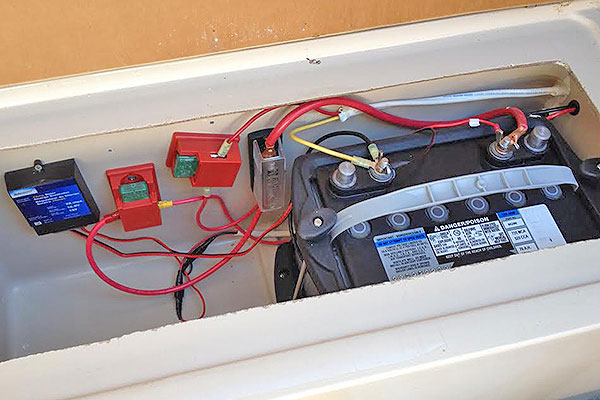
OK - looking at fig 1. Power: I see several things. 1. The solar regulator way over to the left. It's mostly black with a blue label and largely out of the equation. It has 2 very thin #18 wires going directly to the +/- terminals of the battery.
2. The big thick red (+) battery cable. Maybe it's AWG-6 or 8 cable? Note, however it's a very short run and there's no corresponding thick (-) black "return" on the negative terminal.
3. Then there's the clear thing that the fat red wire goes into. I assume that is either a fuse or a circuit breaker. Two AWG 10 or 12 red wires come out of the bottom. << troubleshooting tip: when the power fails again, set your voltmeter to read 20VDC and put the red lead on each end of that thing and place the black lead on the negative terminal. If there's 12.8VDC going in on top but 0.0 VDC on the bottom, there's your problem.>> Coming out of the bottom I see two thinner red wires leading to two secondary fuse boxes, each red with a green fuse.
4. Looking at the leftmost red box with a green fuse first, I see what looks to be a #10 wire going in. Coming out, there's a slightly thinner wire going behind the battery. Does that feed the house? Or does that lead to your engine alternator?
5. The other red box with green fuse in center is fed from the clear box with what looks like #12 wire. Coming out it feeds to a cable that is 12-2 that also carries a yellow (-) cable connected to the negative battery terminal. This pair may either feed the alternator or the house.
<<Troubleshooting tip - after you check item 3 above, if there's power on both sides (12.8VDC), then check the output of item 4 (the right side) and item 5 (the top). If only 1 of those 2 has no power output then you know which one's intermittent. Usually a bad crimp.
I noticed something else. In figure 3, a new red wire appears on the top of item 5 - it has a yellow spade lug on it and looks thicker. What's that for?
Last note: if one of the circuits is fed by your alternator and if a problem cuts power to the battery while the alternator is running, you could damage your alternator regulator circuit.
Don Casey provides a Guide to wire size in his books "Complete Illustrated Sailboat Maintenance Manual" and his "Sailboat Electrics". In there he says this: figure out the max current you expect in each cable run. Assume 30A to the house, 15A to the alternator, etc. then calculate the round trip distance of the leg. I assumed 12 ft from the battery to the breaker panel so my distance was 2x12 or 24 ft. Then look in the AWG table for that combo 30A @ 25' and the AWG number is #6. So you should use 6-2 cable to feed the house.
Bruce Ross Passage ~ SR-FK ~ C25 #5032 Port Captain — Milford, CT
<<< 1. The solar regulator way over to the left. It's mostly black with a blue label and largely out of the equation. It has 2 very thin #18 wires going directly to the +/- terminals of the battery. >>>
The incoming power from the solar panel.
<<< 2. The big thick red (+) battery cable. Maybe it's AWG-6 or 8 cable? Note, however it's a very short run and there's no corresponding thick (-) black "return" on the negative terminal. >>>
<<< 3. Then there's the clear thing that the fat red wire goes into. I assume that is either a fuse or a circuit breaker. >>>
That's the 100 amp fuseable link.
<< Two AWG 10 or 12 red wires come out of the bottom. << troubleshooting tip: when the power fails again, set your voltmeter to read 20VDC and put the red lead on each end of that thing and place the black lead on the negative terminal. If there's 12.8VDC going in on top but 0.0 VDC on the bottom, there's your problem.>>
<<< Coming out of the bottom I see two thinner red wires leading to two secondary fuse boxes, each red with a green fuse. >>>
<<< 4. Looking at the leftmost red box with a green fuse first, I see what looks to be a #10 wire going in. Coming out, there's a slightly thinner wire going behind the battery. Does that feed the house? >>>
#10 going to the main house panel
<<< Or does that lead to your engine alternator? >>>
There are no engine connections whatsoever
<<< 5. The other red box with green fuse in center is fed from the clear box with what looks like #12 wire. Coming out it feeds to a cable that is 12-2 that also carries a yellow (-) cable connected to the negative battery terminal. This pair may either feed the alternator or the house. >>>
That was #10 going to the unswitched subpanel but I changed it to #8
<<< <<Troubleshooting tip - after you check item 3 above, if there's power on both sides (12.8VDC), then check the output of item 4 (the right side) and item 5 (the top). If only 1 of those 2 has no power output then you know which one's intermittent. Usually a bad crimp. >>>
Good point .. I should tug on all crimps.. I found one loose on my main panel earlier..
<<<I noticed something else. In figure 3, a new red wire appears on the top of item 5 - it has a yellow spade lug on it and looks thicker. What's that for? >>>
<<< Last note: if one of the circuits is fed by your alternator and if a problem cuts power to the battery while the alternator is running, you could damage your alternator regulator circuit. >>>
No alternator on the engine or any connections to the engine.
<<< Don Casey provides a Guide to wire size in his books "Complete Illustrated Sailboat Maintenance Manual" and his "Sailboat Electrics". In there he says this: figure out the max current you expect in each cable run. Assume 30A to the house, 15A to the alternator, etc. then calculate the round trip distance of the leg. I assumed 12 ft from the battery to the breaker panel so my distance was 2x12 or 24 ft. Then look in the AWG table for that combo 30A @ 25' and the AWG number is #6. >>>
<< So you should use 6-2 cable to feed the house. >>
<<< Assume 30A to the house >>>
I'm assuming 15 amps to the house.. nowadays each circuit is drawing less than 3 amps ( 3x5 circuits )
It was originally wired from the factory with #10 primary from battery to the house. I've added LEDS for lighting which reduced my power requirements by 100% and rewired with #10 ( and #8 on my unswitched subpanel ) and added fuses from the battery to the house panel and an additional unswitched panel.. a big improvement.
Ray in Atlanta, Ga. "Lee Key" '84 Catalina 25 Standard Rig / Fin Keel
To Bruce's excellent observations, let me add that you really want to get this right. I say that having been 5 miles off the beach and a mile outside of a kelp bed on the Pacific, 10 miles from port on a C-25 (not mine), with smoke pouring out of the "dumpster" and the galley cabinet--clearly burning insulation. It is not a good feeling.
Dave Bristle Association "Port Captain" for Mystic/Stonington CT PO of 1985 C-25 SR/FK #5032 Passage before going over to the Dark Side (2007-2025); now boatless for the first time since 1970 (on a Sunfish).
My bet would be the ground. check all the connections on the ground circuit and clean them. replace bus bar to battery connection. or at least bypass with jumper cables to test. you could reconnect your power adapter at various places to see were the problem is. such as run temp cable from power panel to near the battery , attach short temporary ground. plug in your phone charger and see. This would eliminate your entire ground circuit. do the opposite with the power side.
<< you could reconnect your power adapter at various places to see were the problem is. >>
The problem was a short in the power adapter. I found that. I was wondering if anyone had any experience with the Maxi Fuses, or the slow blow glass fuses resetting.
Ray in Atlanta, Ga. "Lee Key" '84 Catalina 25 Standard Rig / Fin Keel
Yepper.. suddenly all the circuits are losing power, intermittently at first ( Sunday ) and then all out yesterday... So now it looks like Dasreboot is right.. sounds like a bad ground..
Back into the dumpster!
Ray in Atlanta, Ga. "Lee Key" '84 Catalina 25 Standard Rig / Fin Keel
Notice: The advice given on this site is based upon individual or quoted experience, yours may differ. The Officers, Staff and members of this site only provide information based upon the concept that anyone utilizing this information does so at their own risk and holds harmless all contributors to this site.