Notice:
The advice given on this site is based upon individual or quoted experience, yours may differ.
The Officers, Staff and members of this site only provide information based upon the concept that anyone utilizing this information does so at their own risk and holds harmless all contributors to this site.
This weekend Moxie will get her forward ports rebedded and the keel grinding begins to attach the new and improved keel bracket.
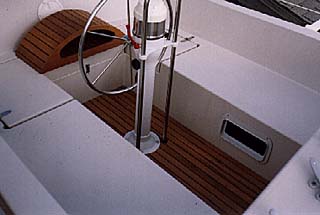
One of the things I wanted to do this winter is to make a slatted "teak" grate for the bottom of the cockpit.
The other day I had a brainstorm (rather painful and totally unexpected)... Since teak is expensive and difficult to obtain locally I thought why not make it out of this plastic wood composite material like Trex.
Anybody use this stuff? It appears that you can mill it like you would real lumber, it will weather well, no need to finish it. Seems like a good fit for a cockpit grate.
Anyway, just thinking out loud again. I'll post the results.
One of our local marinas, Scotty's Cove where Doug G. is slipped, has been using Trex to replace the boardwalk on their floating docks. Although they used a light charcoal grey, it looked very nice and, more importantly, had very good traction; at least in the summer.
It is used for decking, and in South America I've seen it used for everything from doors to furniture. The only disadvantage I've heard from people who've used it, is that you have to frequently sharpen your tools.
It is available, although I'm not sure how widely.
The trex is a great idea. A beach house we use has had a trex deck for years. No splinters, warm, and has weathered very well. They are also replacing our docks with the stuff. I see a lot of failed building materials in my job. I'd have to say the Trex stuff is one of the few engineered materials I think might work out. Makes great stair rails. I'm starting to wonder if hand rails and coaming trim made out of Trex type materials aren't a good idea. Yes, it's heavy, but so is teak. Keep us posted on the project.
<blockquote id="quote"><font size="1" face="Verdana, Arial, Helvetica" id="quote">quote:<hr height="1" noshade id="quote"><i>Originally posted by ClamBeach</i> <br />Trex is pretty heavy stuff... <hr height="1" noshade id="quote"></blockquote id="quote"></font id="quote"> So's Ipe--we used it for our deck, and went through a dozen drill bits and several circular saw blades. (You can't drive a nail through it without predrilling to the diameter of the nail.) The Atlantic City boardwalk and others like it are decked with ipe (pronounced ee'pay). One downside is that it's a little splintery (very small splinters). For a cockpit grate, Trex sounds like a great idea--it's rough but soft in texture, and easier to work.
Clifton, your timing is perfect. See this month's issue of Good Old Boat. Mark Parker gives an update on the Trex deck he installed on his Pearson Triton. His article about installation was in the January 2001 issue.
My GOB came in the mail today. Thanks for the heads up, now I'll have to find that old issue. That must have put the idea in my head to begin with. I'll post photos of the project as it develops.
Trex is hefty, but no more so than wet teak. It also does not "soak up" moisture. As the building industry moves rapidly toward "lumber alternatives" (cementitious board for exterior trim, MDF for cabinet work, to cite just two examples), there is hope that we can reduce the clear-cutting of non-replaceable forest, especially the Rain Forest. Teak, mahogany, and especially Ipe, tend to come not from plantations but from tropical rainforest in Brazil, the Phillipines and Indonesia. Whenever I use a slightly exotic wood for a cabinet or trim on my house, I always ask the lumber yard for a certificate of provenance. They are not 100% true, but it is one way of letting your local lumber yard know that you don't want wood from the rain forest. One advantage of dealing with Lowes and HD is that they are simply too big to risk the firestorm of protest that would occur if they were found to be selling products from virgin rain forest.
"... non-replaceable forest, especially the Rain Forest..."
If allowed to, rain forest grows back very quickly... the aboriginal peoples of those regions have practiced slash and burn (clearcuts) on it for centuries.
The modern problem is that the previously forested land is not being allowed to regenerate. It is instead being converted to rangeland for cattle and other (mostly agricultural)uses.
Population pressures in the third world are extreme. To add to the problem, some cultures (like in Brazil) confer high social status to folks who have cattle ranches. (more status than just having money)
It's ironic that what may be the best way to save the rain forest is to value it's wood resources more than the marginal rangeland or poor quality agricultural plots it is being converted to.
Notice: The advice given on this site is based upon individual or quoted experience, yours may differ. The Officers, Staff and members of this site only provide information based upon the concept that anyone utilizing this information does so at their own risk and holds harmless all contributors to this site.