Notice:
The advice given on this site is based upon individual or quoted experience, yours may differ.
The Officers, Staff and members of this site only provide information based upon the concept that anyone utilizing this information does so at their own risk and holds harmless all contributors to this site.
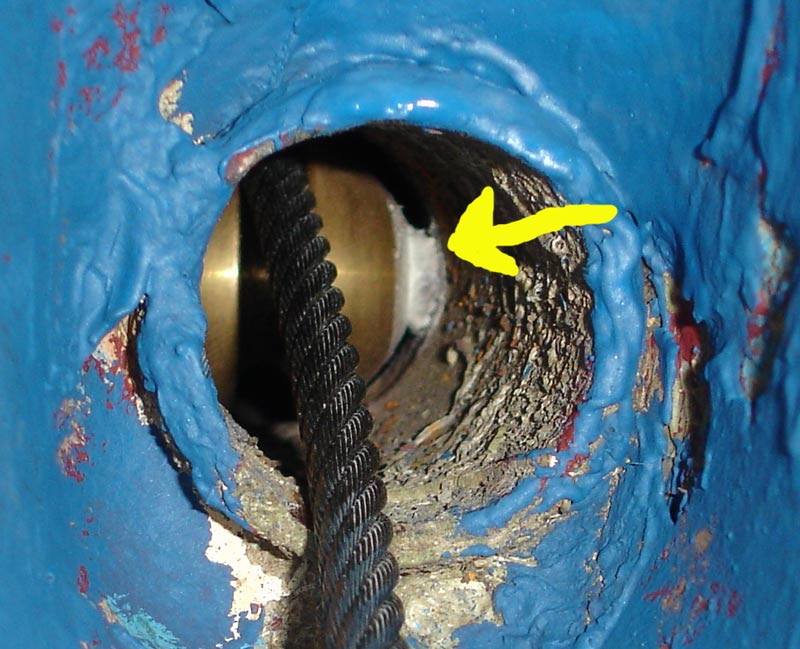
I just redid all my swing keel hardware. I replaced the brass ball and pin. I sealed the exhaust hose that covers the pin with 4200. I didn't realize that some had leaked onto both the pin and the brass ball. See yellow arrow in picture below.
Question: Will the 4200 "break away" after use. I've noticed that cranking the keel up is more difficult than before. Boat was being lauched just before taking the picture and I didn't notice the problem until I went home and looked closely at the image. The boat is in the water and I don't have a way to get to the excess 4200 to cut away. I'm concerned that if the ball doesn't break free I'll wear the ball, cable, or both prematurely.
Another option would be to pour some of the 5200 debonder thru the cable thru hole, hoping that some will get on the 4200 and debond it.
If the ball isn't turning the cable, being of a harder material, will erode the ball and eventually start to fray the cable. I don't know how to debond 4200, sorry. Why did you put 4200 there?
Do you frequently raise and lower the keel? If not, then don't worry about it; you can wait for your next haulout and take care of the problem then. If you raise/lower a lot, you will need to haulout soon and clean the adhesive off so the ball can turn. Otherwise the cable will slice through the ball in short order. A stuck ball will indeed increase the effort required to raise the keel.
I am very sorry this picture is so pourly focused; that said, this shows a cable that has worn completely through the ball and had begun wearing on the stainles pin. I think it would have taken a while for it to get through the pin. But it did change the exit angle so the cable was chewing a groove where it exits the "pipe". Your entire area looks rough, maybe it is what that area looks like on saltwater boats. Your comment about replacing "all of your swing keel hardware" has me confused, the cable does not look new. Anyway, I would not worry too much about it until your next opportunity to haul as long as that is sometime this season
What a tidy bilge Frank, Thats where I store varnish, paint and extra west epoxy. Good thing I don't need to get in there very often, I keep the abandon ship bag under the steps.
Albert, How about a hack saw blade gently working through the gunk until it's free.
Good timing as I am changing all the swing keel hardware except the cable. Problem showed up with the size of the recess in the keel for the non turning new fitting attached with an allen head bolt which I will have to cut larger in the cast iron (not in the instructions). Also the direction of the new fitting with the offset hole for the allen head bolt. Help needed. Also good news so far as I had used permatex #2 for the threads 20 years ago and the fitting came out of the keel with no rust and damage. Instuctions now say to use loc-tite with cleaner for threads?
Suggestion: find a friend or pay a diver to go under with keel fully deployed, with an underwater light. Watch up the hole to see if ball turns (you only need one crank to find out) If not, have diver stick a sharp tipped fillet knife up there and try to just part (gently) the ball from the goop,of course NOT carving on the hose portion, it appears that only a slight bleedthrough has occurred to the ball. This might work, nothing venture, etc...Ron srsk Orion SW FL
<blockquote id="quote"><font size="1" face="Verdana, Arial, Helvetica" id="quote">quote:<hr height="1" noshade id="quote"><i>Originally posted by dlucier</i> <br />Is there any way to peer down the cable hose from inside the cabin while cranking the keel to see if the ball spins? <hr height="1" noshade id="quote"></blockquote id="quote"></font id="quote"> He could use a resonance vibrometer to see if the harmonics of the standing wave created by the friction co-efficient matches that of a dragging cable or a rolling ball.
There is no way to replace the designed stand pipe with any other device. Lets face it, we have a hole in our boats. After my first year with one I have been very pleased that there is no odor from the lake water.
<blockquote id="quote"><font size="1" face="Verdana, Arial, Helvetica" id="quote">quote:<hr height="1" noshade id="quote"><i>Originally posted by fhopper@mac.com</i> <br /><blockquote id="quote"><font size="1" face="Verdana, Arial, Helvetica" id="quote">quote:<hr height="1" noshade id="quote"><i>Originally posted by dlucier</i> <br />Is there any way to peer down the cable hose from inside the cabin while cranking the keel to see if the ball spins? <hr height="1" noshade id="quote"></blockquote id="quote"></font id="quote"> He could use a resonance vibrometer to see if the harmonics of the standing wave created by the friction co-efficient matches that of a dragging cable or a rolling ball.<hr height="1" noshade id="quote"></blockquote id="quote"></font id="quote">
Uhhh...Does this mean he can't peer down the cable pipe and observe the turning ball?
Notice: The advice given on this site is based upon individual or quoted experience, yours may differ. The Officers, Staff and members of this site only provide information based upon the concept that anyone utilizing this information does so at their own risk and holds harmless all contributors to this site.