Notice:
The advice given on this site is based upon individual or quoted experience, yours may differ.
The Officers, Staff and members of this site only provide information based upon the concept that anyone utilizing this information does so at their own risk and holds harmless all contributors to this site.
Ok, this is my delemia. I have to put in a new mast wiring harness, the old one is not set up to run my new steaming/deck light mount that I just bought. I dont mind buying the harness, it comes with all the good stuff I need, I already have a new 4 prong connector. I think my hang up is drilling thru the deck into the cabin, as recomended by CD tech help. I just want to make sure that I dont get an unwanted leak. Advice is needed. Thanks, Barry
Barry, I've been there and done that. Use some LifeCaulk or similar sealant around the base of the connector, and you'll be fine. The connector should have a rubber gasket as well. I've never had a leak around that plug base.
It's scary the first time you drill through the boat, but all will be well.
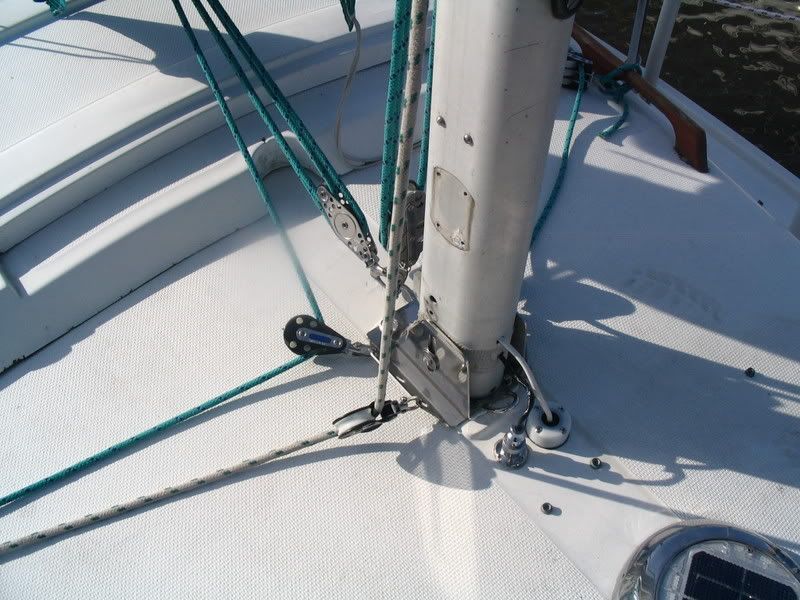
Hi Berry, I agree with Brooke. Use good sealant and only drill a hole the exact size you need. Here is a shot of the deck connectors I put on my boat when I rebuilt the mast. If you think drilling through the top deck is freaky, wait until you need a Throw-hull. Cheers.
When I rewired my C-25, I installed a 5-pin (Marinco?) thru-deck connector for the mast wiring. (2nd boat I've used one on.) For added peace of mind, you might want to protect the wood deck core exposed in the hole with a few coats of epoxy resin, sanding off any wood splinter bristles between coats.
I rewired the mast last summer and rewired to a new switch panel this winter including replacing the deck connector. I had thought that the existing wiring thru the cabin top could not be pulled thru since others had indicated the wiring was encapsulated between the cabin top and liner. (More on that later.) So in order to rewire, removing the deck connector, I used a long shaft drill bit and drilled at an angle inside the deck connector cabin hole, aiming forward to ensure the new hole would penetrate the inside of the cabin forward of the bulkhead into the [otapotti cabin area. After drilling, I could not find the hole and thought I had not penetrated that area but closer inspection indicated the hole did penetrate forward of the bulkhead but was into the rubber molding and so the rubber closed up the hole and I had not immediately seen it. Then I installed a new deck connector and the wiring. Since it was winter, I did not use the 3M 4200 sealant under the deck connector - too cold outside. I taped down a foam cup over the connector with the mast wiring sticking out of it. Once the warm weather came, I then put a ring of sealant under the connector and finished the project.
Regarding the existing wiring and it being encapsulated inside the cabin top and liner...well let me say that is not always the case. What I found was that when I was removing old wiring no longer used, I then came about the old mast wiring that was replaced this winter. The old wiring was inside a plastic sheath under the bilge cover. The wiring then went up the wood mast support column. I noticed that the wire could be wiggled inside that column and so....since it was no longer used, I gave it a strong tug and ....it came out all the way from the deck connector hole. SO...at least on my '89, it appears the wire is not encapsulated between the cabin top and liner but is a ver snug fit thru the original cabin top/liner hole to the deck connector. Possibly, if I had known this earlier, I would not have had to drill a new hole but could have tugged away at the old wiring and then widened the original hole and then snaked thru the new wiring.
As it turns out, drilling the new hole was not such a big deal and since it was inside the hole for the deck connector, the area will not see any water as long as the deck connector is resealed which is what is necessary anyway.
To better protect the mast wires and deck connector, I ran the last foot or so of wiring from the mast through a piece of automotive fuel line. This fuel line shields the wiring from the elements and provides strain relief. It also acts as a grommet going into the mast. The boot over the connector itself is a dishwasher disposer adapter.
Notice: The advice given on this site is based upon individual or quoted experience, yours may differ. The Officers, Staff and members of this site only provide information based upon the concept that anyone utilizing this information does so at their own risk and holds harmless all contributors to this site.