Notice:
The advice given on this site is based upon individual or quoted experience, yours may differ.
The Officers, Staff and members of this site only provide information based upon the concept that anyone utilizing this information does so at their own risk and holds harmless all contributors to this site.
I'm thinking about installing a solar panel for keeping up the batteries both when I'm not with the boat and also for when I am cruising for a couple of days. I don't depend on the outboard alternator to charge anything but the starter battery. So the question is, how large a panel in watts should I be looking at? I know that this depends a lot upon consumption. We are pretty conservative and have LED lights below on half our internal lights and LED bulbs in the running and anchor lights, typical VHF usage and maybe some CD stereo. Only instrumentation is the light on the compass. Everything else is self powered, like the hand held GPS. The follow on question is where is the best place to install such panel on the Cat 25? If anyone has experience installing and using a solar panel, I would appreciate any input you have on wiring, components, costs, sources, etc.
Steve Krenz `Elan 1978 SR/SK #482 Santa Fe, New Mexico
I use a solar panel on the boat when its not in use, I dont think it will do much good while consumers are in use, they usually just maintain a battery, although Im sure you can buy a large one with more power, but Im sure it wouldnt be cheap Im lucky I have shore power hookup at the marina
I have 3, 11-watt United Solar Flexible panels. They plug into a cigarette lighter type plug, although I changed plugs. I also wired all 3 together. There is no installation. You can throw them on the deck, in the cockpit, or when cruising I tie mine to the boom. They do make a single 33 watt panel. This will last you with moderate electrical use when cruising without needing the engine alternator. Worked on a 3 week cruise with no shore power and no engine with instruments (fish finder, GPS, Autopilot), lights, stereo, and watching a DVD on the computer now and then. I started with 2 panels and then upgraded to 3 the next year. These are literally bullet proof. You can walk on them and the sales guy said you could fire a 45 caliber slug through them and they would still work.
For full time keeping the battery at charge when not using the boat I think you could get by with a 5 watt. If you use one of your 11 watt panels, just throw it on a cockpit seat and it will not get so much sun. You can always buy a charge controller which Discover Power (where I bought mine) has for $35. The 11 watt panels were $95 each.
Jim, that sounds like a good system that would satisfy the needs of most boats. Is it complicated to wire them, and do the panels come with wiring instructions? Do you have to solder any connections, or are the connections all mechanical? When you plug them into the cig. lighter outlet, do you turn the battey switch to "both" to charge both batteries, or to the one battery that you want to charge? What factor determines whether you need a controller? If you don't get one, do you have to frequently monitor the batteries' charge, to make sure you don't overcharge them? Do I understand correctly that all you have to do is wire the three panels together, and add a cig. lighter plug, and perhaps wire them to a controller, and that's it? Do you have to add any wiring to the boat's electrical system?
I want to do some cruising this season, and this sounds like something a technologically challenged guy might be able to do.
Looks like you have pretty good info from above responders. Based on some books and experience using my own solar panel, I would say you need a solar panel with nlt the watts shown below for different functions.
Trickle charging the batteries - .4AMP/day Summer per battery (.25AMPS/day winter per battery)
Then add to that: Each week: 2 nights nav lights for 2 hrs each night - 2hrsx2nightsx2 bulbs @.9Amps/ea = 7.2Amps .... .. OR.. .. 1 Night-time Anchor Light (.9Amps) x ~ 10 hrs = 9Amps
A 20 watt solar panel will put out a max of 1.2 AMPS per Hr but because of less than ideal conditions w/angle to sun, etc actual output (.4-.8AMPS) closer to about .6AMPS/Hr for 5+ hrs = 3AMPS per day minimum. Depending on average number of full sun/partial sun days and efficiency of your panel figure you will get about 3AMPS/Day x 4+ days = 12AMPs.
You should be able to count on about 12AMPS/week out of a 20Watt Panel unless your location gets few sun days each week.
If you have an LED Anchor light, then a 20 watt panel should be able to give you some hours 2 nights each week w/Nav Lights and a night with the anchor light and trickle charge two batteries and probably be able to run LED Cabin lights for a couple of hours 2 nights. That will then max out a 20 watt panel.
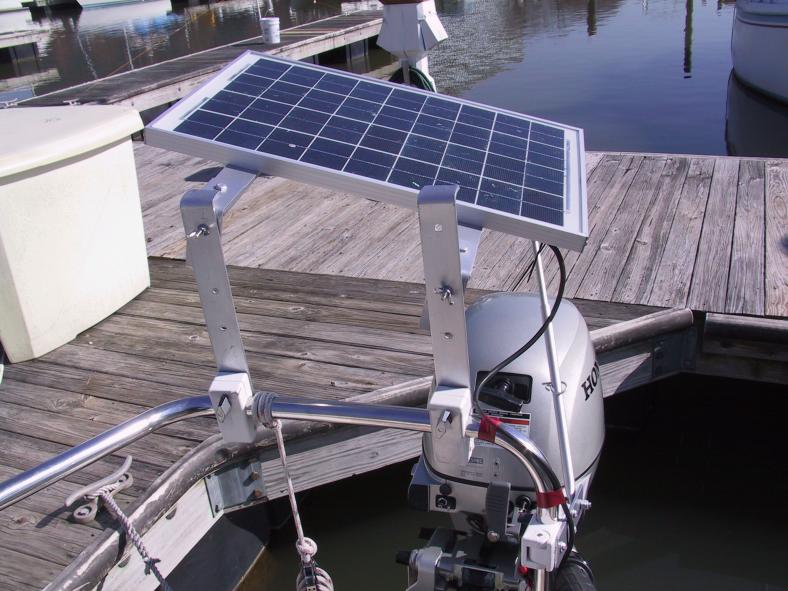
If all incandescent bulbs and/or want more loads running each week including possibly a radio, then need to go to a 30watt minimum...maybe 40watt if really cranking the loads. Here's a 20watt setup - More details on my website:
Is it complicated to wire them, and do the panels come with wiring instructions?
Wires are red and black color coded and come with a cigarette lighter type plug installed, there is also a quick disconnect plug near the panel itself. I cut these wires and joined all the panels together in parallel. It would be better to buy a 33 watt panel the first time!
Do you have to solder any connections, or are the connections all mechanical?
I chose to solder my connections and put shrink tubing on them but you could use butt splices.
When you plug them into the cig. lighter outlet, do you turn the battey switch to "both" to charge both batteries, or to the one battery that you want to charge?
Depends on how your cigarette lighter plug is wired but yes, mine goes to the 1, 2 or both switch. I actually took the cigarette lighter plug off mine and put on a 2 pronged plug from West Marine, I have made these standard on my boat so I can plug the panels in anywhere, including my autopilot plug.
What factor determines whether you need a controller? If you don't get one, do you have to frequently monitor the batteries' charge, to make sure you don't overcharge them?
On a cruise you'll be monitoring your voltage anyhow so it doesn't really matter - you are not going to overcook the batteries. These read about 25 volts full sun, no load. Over a long, long time they would boil away your electrolyte in the batteries. I think the formula is don't exceed 10% of the amp hour capacity of your battery bank without the controller. I bought one and don't use it, however, it will limit the voltage to no greater than 14.1 - good for my Gell batteries.
Do I understand correctly that all you have to do is wire the three panels together, and add a cig. lighter plug, and perhaps wire them to a controller, and that's it? Do you have to add any wiring to the boat's electrical system?
None, that is the beauty of this. Throw the panels on deck, on the cockpit seats, or do as I do and tie them to the boom, plug in, and you're done. When the batteries are charged you can fold it up and throw it under a setee.
You get usefull power even on a cloudy day. On a typical day at anchor my batteries are fully recharged by afternoon - even with the usual morning clouds.
Jim, I'm interested in what you mean when you talk about "when cruising I tie mine to the boom." I'm trying to picture this. Can you describe more fully or better yet, have a picture?
What I mean is "when cruising and anchored in some remote, beautiful cove, I furl the main sail, cover it, and then put the flexible solar panels on top. The panels have grommets in each corner. I run a light line through the grommets and around the boom and tie it, holding them in place. I then run the wire down into the cabin and plug it in."
When underway, if I felt I needed to charge, I just throw the panels on the cabin top and use the same grommets to tie them to the hand rails.
You guys are killing me with all these giant solar panels hanging off the boats etc,,, dosent anybody have power they could hook up to when docking? or is everybody moored out ,, maybe thats it,,,,
My marina separately charges for the electricity. It would be $20/month for me. I really do not see paying for the electric for my few needs. But...probably the over-riding factor was....I wanted to work on a project.
I am in the process of installing solar panels on my Cat25. I have two 85Watt BP solar panels. I bought an MPPT charge controller of sufficient capacity to deal with the combined 170Watts. I'm in the process of building a bimini that will hold the two panels (each panel is 4'x 2') and a piece of smoked plexiglass to complete the top. I just got all of the fuses and tinned wire to complete the electrial connections. I picked up a 1000Watt (2000Watt surge) power inverter and will hard wire it through the AC system with an A/B switch so that I can switch from shore power to inverter when needed. I haven't done this before so I'm kind of making it up as I go along. Both the construction of the bimini and the electrical hookup look pretty simple, but I am running out of spaces to mount switches, boxes, panels, etc. When I'm done, I will provide specifics of how I hooked everything up, thus addressing the original post. I think that I may have gone too far with this one.
<blockquote id="quote"><font size="1" face="Verdana, Arial, Helvetica" id="quote">quote:<hr height="1" noshade id="quote"><i>Originally posted by skrenz</i> <br /> We are pretty conservative and have LED lights below on half our internal lights and LED bulbs in the running and anchor lights, typical VHF usage and maybe some CD stereo. Only instrumentation is the light on the compass. Everything else is self powered, like the hand held GPS. <hr height="1" noshade id="quote"></font id="quote"></blockquote id="quote"> You've gotten good info on the solar panels, but if you want to reduce your consumption further replace the CD with an MP-3 player.
Notice: The advice given on this site is based upon individual or quoted experience, yours may differ. The Officers, Staff and members of this site only provide information based upon the concept that anyone utilizing this information does so at their own risk and holds harmless all contributors to this site.