Notice:
The advice given on this site is based upon individual or quoted experience, yours may differ.
The Officers, Staff and members of this site only provide information based upon the concept that anyone utilizing this information does so at their own risk and holds harmless all contributors to this site.
According to early reports on the late news, it appears a US Battleship collided with an oil tanker in the Straights of Hormuz. Apparently both ships were approaching one another when the battleship turned to port (left) in front of the tanker resulting in a collision. The Navy commander was reportedly on the bridge at the time and may be facing charges. Stay tuned (weren't we just talking about this a few weeks ago?)
Bruce Ross Passage ~ SR-FK ~ C25 #5032 Port Captain — Milford, CT
DUBAI, United Arab Emirates — A U.S. Navy guided missile destroyer was left with a gaping hole on one side after it collided with an oil tanker early Sunday just outside the strategic Strait of Hormuz.
The collision left a breach about 10 feet by 10 feet (three by three meters) in the starboard side of USS Porter. No one was injured on either vessel, the U.S. Navy said in a statement.
The collision with the Panamanian-flagged and Japanese-owned bulk oil tanker M/V Otowasan happened about 1 a.m. local time. Photos released by the Navy showed workers standing amid twisted metal and other debris hanging down from the hole.
The cause of the incident is under investigation, the Navy said, though the collision was not "combat related." There were no reports of spills or leakages from either the USS Porter or the Otowasan, the Navy said.
Navy spokesman Greg Raelson said the destroyer now is in port in Jebel Ali, Dubai. "We're just happy there were no injuries," he said. "An investigation is under way."
The USS Porter is on a scheduled deployment to the U.S. 5th Fleet, which is based in Bahrain, an island nation in the Gulf, near Iran.
The Strait of Hormuz, at the mouth of the Gulf, is a crowded and tense waterway where one-fifth of the world's oil is routed. Tensions have risen there over repeated Iranian threats to block tanker traffic in retaliation for tighter sanctions by the West. The sanctions are aimed at persuading Iran to abandon its uranium enrichment program, so far without success.
Tensions in the Strait of Hormuz show no sign of abating.
The United States stoked the flames recently with an announcement that it will send U.S. Navy minesweepers and warships into the Gulf for exercises. The U.S. military maneuvers scheduled for September, to be joined by ships from about 20 American allies.
<blockquote id="quote"><font size="1" face="Verdana, Arial, Helvetica" id="quote">quote:<hr height="1" noshade id="quote"><i>Originally posted by Voyager</i> <br />Not to open a can of worms but what is the distinction? Size, number of cannon, armor, electronics, number of crew? <hr height="1" noshade id="quote"></font id="quote"></blockquote id="quote">
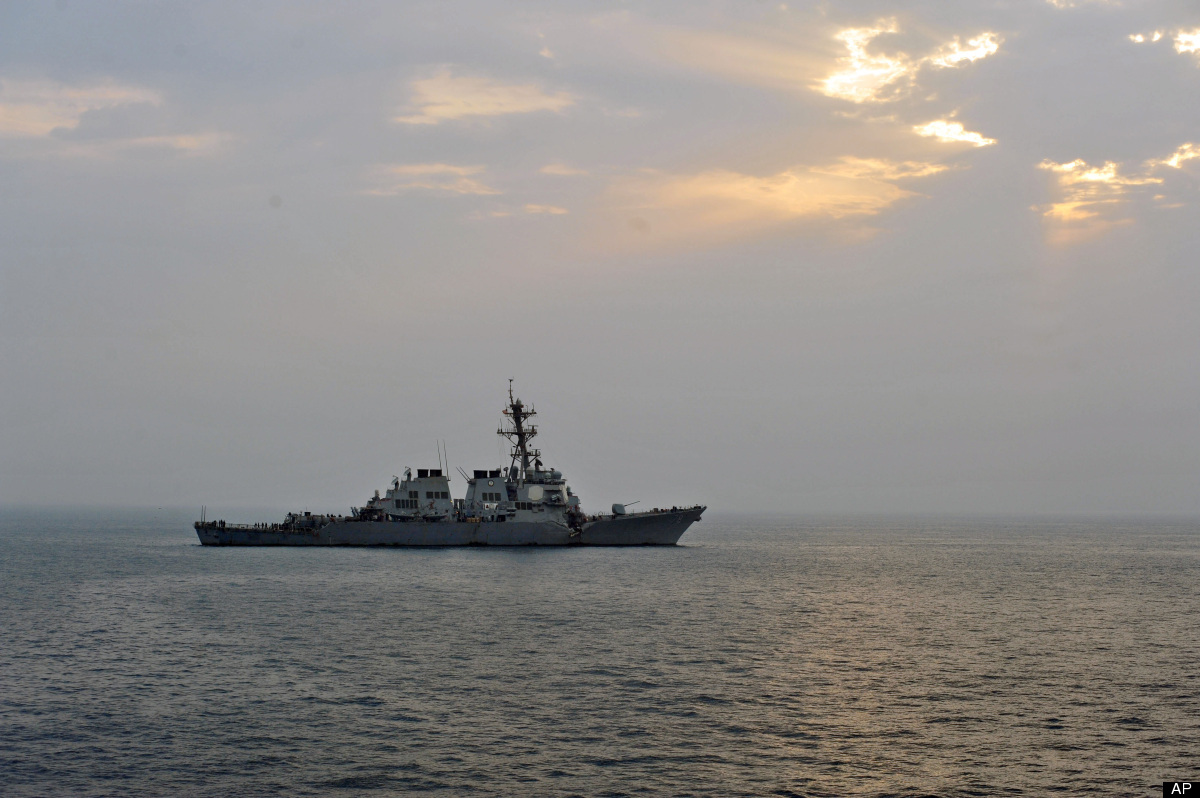
<blockquote id="quote"><font size="1" face="Verdana, Arial, Helvetica" id="quote">quote:<hr height="1" noshade id="quote"><i>Originally posted by Voyager</i> <br />Not to open a can of worms but what is the distinction? Size, number of cannon, armor, electronics, number of crew? <hr height="1" noshade id="quote"></font id="quote"></blockquote id="quote"> Destroyer USS Porter:
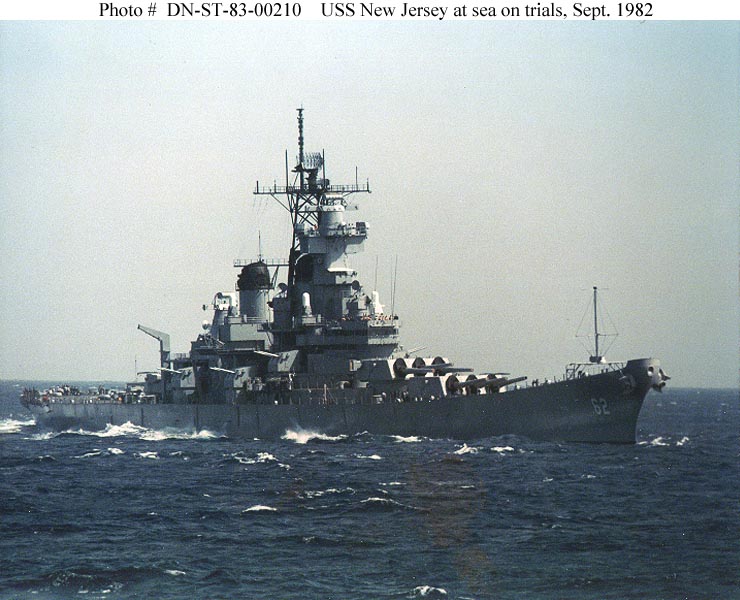
Battleship New Jersey:
Since it takes 2 to tango, let's not forget that the oil tanker's helmsman might not have known his left hand from his right hand either. Regardless, the Porter's skipper will probably, unfortunately, find it hard to get promoted in future.
Why weren't these guys in communications w/ each other? Local commercial marine operators are regularly advising via the radio of their movements and intentions...
The difference between a destroyer and a battleship are numerous. The guided missile destroyer I was on had about 350 guys on it, a modern one probably has roughly 2/3 that many. A battleship (none of which are in service, and haven't been for decades) can have as few as 1500 to nearly 3000 men on board, depending on whose navy and which ship. Also battleships are enormous compared to destroyers. My Adams class destroyer was about 440' long as I recall, and the New Jersey class of US battleships were about 900' long.
I wonder if this was a radar assisted collision? I've read about them in a couple of my books, the most famous being the [url="http://en.wikipedia.org/wiki/SS_Andrea_Doria"]Andrea Dorea & Stockholm collision.[/url] Maybe a junior radar operator was on the set that night. Seems improbable though, even consumer grade radar sets can now give you closest point of approach, I'd assume the USN has much better equipment.
The skipper of the Porter is likely to be simply cashiered out of the USN after the inquiry is over, even if it were shown to be the Japanese tanker's "fault". At a minimum he'll never command another ship and is likely to drive a desk the rest of his career.
I haven't seen any reports of the directions and turns, but there are photos of damage on the starboard side of the Porter, which would be expected if he turned to port in front of the tanker if they were head to head, or starboard if the Porter was overtaking.
<blockquote id="quote"><font size="1" face="Verdana, Arial, Helvetica" id="quote">quote:<hr height="1" noshade id="quote"><i>Originally posted by delliottg</i> <br />A battleship (none of which are in service, and haven't been for decades) <hr height="1" noshade id="quote"></font id="quote"></blockquote id="quote">
I served as a UH-1H Huey Crewchief during the Gulf War. Although I never saw her, we knew the Mighty Mo was offshore, firing Tommies and her big 16" guns. It was a real honor serving along side her.
We did gunnery drills with the Missouri down in the Caribbean in the mid-eighties. They were firing full port broadsides at Eleuthera Island as well as their Phalanx CIWS (radar guided 20 mm gatling gun). All at twilight, about 300-400 yards astern and starboard of us. Our 5" main guns were like popguns compared to their 16" main guns. Plus we could only fire two rounds at once, they could fire nine, and their shells were about a ton a piece as I recall. We carried ours onboard by hand at about 70lbs each. No comparison. Wish I'd have had a video camera to record it with.
With 10 years active duty in the Navy I learned there were LGBs and BGBs, Little Grey Boats and Big Grey Boats. I was as aviator so I knew what a carrier was but not the small boats.
Battle ship or destroyer, as an ex navel officer, I can tell you that that captain's career is over, even if they had the right of way. Two things you better not do if yer the boss... Run the boat aground and 2, have a collision with anything. There are no excuses and no second chances.
<blockquote id="quote"><font size="1" face="Verdana, Arial, Helvetica" id="quote">quote:<hr height="1" noshade id="quote"><i>Originally posted by andy</i> <br />...I can tell you that that captain's career is over...<hr height="1" noshade id="quote"></font id="quote"></blockquote id="quote">...as it should be. In the case of a destroyer and a supertanker, the old unwritten "Rule of Tonnage" applies, along with all the other <i>written</i> rules--too many to list here--that are there to avoid collisions and, in the final analysis, rarely let <i>either</i> captain off the hook.
By the way, I'm not saying this was a factor here, but the larger the ship that's approaching you, the greater the illusion that it isn't going nearly as fast as it really is. It is very easy for us small-boat skippers to be fooled by the closing rate of a ship. Be very careful about crossing in front of the big boys who are even a mile or more away and appear to be moving slowly--or better yet, <i>just don't.</i>
Sound advice. We spent a lot of yesterday dodging around the <i>sterns</i> of much larger vessels. Most deceiving are the ones going from a dead start to 20+ knots in a very short amount of time. It can easily appear that you've "got them" around their bow, until you realize that their speed is changing rapidly and no, you really don't, and the time you spent thinking you did has put you further into jeopardy.
The following is the official US Navy release on the collision of USS Porter (DDG 78) and the Japanese owned bulk oil tanker M/V Otowasan.
No one was hurt Sunday morning when a U.S. Navy guided missile destroyer and a large Japanese owned merchant vessel collided near the Strait of Hormuz.
The collision between USS Porter (DDG 78) and the Panamanian-flagged bulk oil tanker M/V Otowasan occurred at approximately 1:00 a.m. local time.
Porter transited under its own power to Jebel Ali, UAE and is now pierside for assessment and repair.
The incident is under investigation.
USS Porter is on a scheduled deployment to the U.S. 5th Fleet area of responsibility conducting maritime security operations and theater security cooperation efforts. 5th Fleet has released a short video on YouTube of the damage. More pictures are here. That second picture appears to show some water being pumped out, some sort of flooding control from broken pipes maybe?
That has to be about the location of the incident, but that is very odd considering the damage on the destroyer was on the starboard front. The last AIS report before it pulled that Crazy Ivan maneuver above was 14.1 knots heading 74 degrees at 12:51am. At 12:55am the ship was slowed to 9.7 knots heading 122 degrees, so presumably the collision had already occurred? If you zoom in you can see see the track where a small box forms, which may be the area where the destroyer came to a full stop and the tanker circles around the ship passing behind, across the port side for a bit, then circles around and passes in front of the destroyer before resuming course.
If you boat in an area with shipping lanes, like the Puget Sound, there are a few critical things to know. These are nothing new to experienced sailors and are extremely important. Know the CONSTANT BEARING DECREASING RANGE rule...that's a collision course. Realize huge ships travel at a high rate of speed in charted shipping lanes and even if they see you can do NOTHING to change course or speed quickly. A large vessel may require MILES to stop. The laws of physics are in play.
I hear you - I'm in between Bridgeport and New Haven. There are large tugs with tanker barges for oil, gasoline, coal, bananas, cement - you name it, as well as local ferry service traveling between 12 and 15 kts. These guys don't mess around so whenever I see the bow of one othese ships, I'm GONE! Outta there. There is no reason to be in anybody's way out there! You're not proving a point or showing your manhood. These guys and gals are working and are doing their jobs - stay out of their way.
I'm about to do my first coastal race, from Galveston to Port Aransas, The Harvest Moon Regatta. It's been a long time since I've had to deal with ships, being a lake sailor. Is there a quick and decent resource for navigating amongst ships? I won't be the skipper but I do want to have knowledge.
Peter, nothing to offer here except good luck on your voyage! I'm planning to spend the next year honing my skills and hope to race the Harvest Moon next year when I move to the coast. Be sure to post a report and pics after the race!
<blockquote id="quote"><font size="1" face="Verdana, Arial, Helvetica" id="quote">quote:<hr height="1" noshade id="quote"><i>Originally posted by Stinkpotter</i> <br /><blockquote id="quote"><font size="1" face="Verdana, Arial, Helvetica" id="quote">quote:<hr height="1" noshade id="quote"><i>Originally posted by andy</i> <br />...I can tell you that that captain's career is over...<hr height="1" noshade id="quote"></font id="quote"></blockquote id="quote">...as it should be. In the case of a destroyer and a supertanker, the old unwritten "Rule of Tonnage" applies, along with all the other <i>written</i> rules--too many to list here--that are there to avoid collisions and, in the final analysis, rarely let <i>either</i> captain off the hook.
I wonder what the last 30 seconds were like. <hr height="1" noshade id="quote"></font id="quote"></blockquote id="quote">While I agree that the Captain can kiss his any career advancement goodbye, after my 23 years in the military, I still think that is one of the dumbest practices/ideas ever. How can one guy be responsible for every action of every person on board a ship? As in the rest of the world? He can't. People make mistakes, equipment fails. The only thing a Captain, or any other supervisor, can do is assure adequate training, resources and best possible conditions for his crew. I would agree that if the captain were to fail in these areas, his career should be over. If an adequately trained and prepared helmsman panicked as he saw an approaching tanker and turned the wrong way, we have an expression for that. $%^# happens. It was an accident, nothing more, nothing less. If it was willful misconduct, the Captain's responsibilites are the same. Did he do everything possible it assure the "condition" of that helmsman was as it should be? If so, no blame should be found on the Captain. Again, $%^# happens!
Besides, from the accounts I've read, the only person suggesting that the destroyer made an error by turning to port was Bruce. The facts of the incident have not been released or, maybe even found. It's equally plausibe that the tanker's crew made some egregious error and the bridge of the destroyer was attempting to limit potential damage. Who knows?
<blockquote id="quote"><font size="1" face="Verdana, Arial, Helvetica" id="quote">quote:<hr height="1" noshade id="quote"><i>Originally posted by AquaHolic</i> <br />Peter, nothing to offer here except good luck on your voyage! I'm planning to spend the next year honing my skills and hope to race the Harvest Moon next year when I move to the coast. Be sure to post a report and pics after the race! <hr height="1" noshade id="quote"></font id="quote"></blockquote id="quote">
<blockquote id="quote"><font size="1" face="Verdana, Arial, Helvetica" id="quote">quote:<hr height="1" noshade id="quote"><i>Originally posted by John Russell</i> <br /><blockquote id="quote"><font size="1" face="Verdana, Arial, Helvetica" id="quote">quote:<hr height="1" noshade id="quote"><i>Originally posted by Stinkpotter</i> <br /><blockquote id="quote"><font size="1" face="Verdana, Arial, Helvetica" id="quote">quote:<hr height="1" noshade id="quote"><i>Originally posted by andy</i> <br />...I can tell you that that captain's career is over...<hr height="1" noshade id="quote"></font id="quote"></blockquote id="quote">...as it should be. In the case of a destroyer and a supertanker, the old unwritten "Rule of Tonnage" applies, along with all the other <i>written</i> rules--too many to list here--that are there to avoid collisions and, in the final analysis, rarely let <i>either</i> captain off the hook.
I wonder what the last 30 seconds were like. <hr height="1" noshade id="quote"></font id="quote"></blockquote id="quote"> ...Besides, from the accounts I've read, the only person suggesting that the destroyer made an error by turning to port was Bruce. The facts of the incident have not been released or, maybe even found. It's equally plausibe that the tanker's crew made some egregious error and the bridge of the destroyer was attempting to limit potential damage. Who knows? <hr height="1" noshade id="quote"></font id="quote"></blockquote id="quote"> Good point. Also plausible but not likely that one of the ships had a mechanical failure of the steering system or lost power like the freighter on the Missisippi a few years ago that collided with the docks and mall in New Orleans.
I'm not sure of the night conditions where this accident happened but it's possible on a dark night with little background lighting to get optical illusions which might give the illusions that a turn to the left would help them avoid the tanker when in fact it had the opposite effect. For that to happen though would require gross negligence by not checking the radar which is highly unlikely.
Most likely we'll probably never know the real facts.
Notice: The advice given on this site is based upon individual or quoted experience, yours may differ. The Officers, Staff and members of this site only provide information based upon the concept that anyone utilizing this information does so at their own risk and holds harmless all contributors to this site.