Notice:
The advice given on this site is based upon individual or quoted experience, yours may differ.
The Officers, Staff and members of this site only provide information based upon the concept that anyone utilizing this information does so at their own risk and holds harmless all contributors to this site.
I'm a fan of both belt and suspenders. I buy the flares every 3 years (and our USPower Squadron held a demo - you'd be surprised how many old flares did not work). I have a strobe on three PFDs. I have a large orange flag and a hand mirror for daytime. And a million candle power flashlight with which I can signal an SOS. Two VHFs, one with DSC. I hope I never need them. I do get a Vessel Safety Check every spring and once the Coasties see the decal on my portlight, they wave and smile. I'd advise everyone to get one from the USPS or USCGAux
<blockquote id="quote"><font size="1" face="Verdana, Arial, Helvetica" id="quote">quote:<hr height="1" noshade id="quote"><i>Originally posted by britinusa</i> <br />...Assuming that your boat had power, then VHF could be used (line of sight). If no boat power, then handheld VHF (ditto)...<hr height="1" noshade id="quote"></font id="quote"></blockquote id="quote">Not completely true. VHF waves do go over the horizon and over high land masses, as I've demonstrated it numerous time--for example talking to another boat with a 100+ foot land mass between us. (VHF doesn't bounce off the ionosphere like AM and SW signals, so it won't go around the world.) Coast Guard receivers can pick up transmissions from far over the horizon. For example, if your mast-head antenna is 36' above the water, it is over the horizon just 7.5 miles out. Of course, the height of the receiving antenna is part of the equation, but another one the same height is over the horizon from yours at 15 miles. Meanwhile, the Coasties can generally hear you from something like <i>50 miles</i>. That's because the signal propagates over the horizon much like water waves bend into a bay, and because their receiving equipment along the coasts has tremendous sensitivity. When I needed them once, they picked up my handheld from probably 10+ miles--I can't say for sure, but I can pretty much guarantee at 6' above the water I was over the horizon (3 miles away). Likewise, their transmitters have much greater power than the public is allowed to use, so when needed, they can both hear and speak to you way out there (from most of our perspectives--maybe excluding Sten's).
For anyone on the coasts or Great Lakes, the VHF is your ticket to all kinds of help, including the Coasties broadcasting to other vessels whatever they know about you. I listen to these communications frequently, and am convinced this is the first and by far best way to get assistance on the water. My most important "belt and suspenders" are my two VHFs--the other one being battery-powered in my bag.
I'll jump in here to remind everyone that if you have a GPS hooked up to your DSC radio, then pressing the "distress" button will send out your GPS coordinates to every boat that also has a DSC radio. This is a huge safety benefit, since an emergency is not a time when you want to be reading lon/lat coordinates to someone over the radio.
(FYI, if you place a routine DSC call to another vessel with DSC, your coordinates will also show up on his display.)
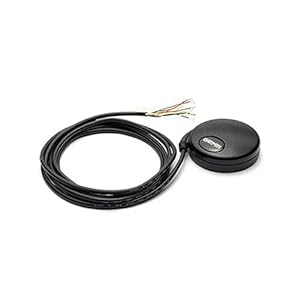
The GPS hookup to your radio can be accomplished easily from a chartplotter, handheld GPS, or my favorite is this, which I have hooked up to my radio in the cabin. It ensures that the radio ALWAYS gets coordinates even if my handheld goes dead:
FYI, I also split the signal wire to a Bluetooth transmitter, so my Netbook and Nook Color (Android tablet with no internal GPS) can also display my location. The Netbook mounts in my cockpit and is running constantly in dry weather, so I have continuous verification that the VHF is getting a GPS signal.
Notice: The advice given on this site is based upon individual or quoted experience, yours may differ. The Officers, Staff and members of this site only provide information based upon the concept that anyone utilizing this information does so at their own risk and holds harmless all contributors to this site.