Notice:
The advice given on this site is based upon individual or quoted experience, yours may differ.
The Officers, Staff and members of this site only provide information based upon the concept that anyone utilizing this information does so at their own risk and holds harmless all contributors to this site.
The ones on that boat look a lot longer and narrower however. I don't know who made them. Rig-Rite might (and would likely be your only source if they are no longer being made).
It's a funny sensation checking out a new thread for the first time and seeing a picture of my own boat!
Those exit plates are Ronstan RF6031's, and I got them at Defender (SKU 602382 - currently $17.81).
Here's a photo of two slots, one with the plate installed and the other without:
They have a single screw at the bottom, and the top uses a tang that slips up inside the mast at the upper end of the slot. Bend that down a little closer to flat so it hugs the inner surface of the mast instead of projecting into the interior space, so the line going up the interior doesn't have to go over the edge at the end of the tang.
Hey, I knew I had done a sketch; here it is - hope it helps.
BTW, once you get over the initial apprehension about cutting into your mast the work is actually pretty easy. Good luck.
Thanks Lee. I'm thinking about copying your shroud rigging as well. I have to replace the uppers and I'm still toying with idea of making the mod. No worries on cutting into the mast. That's the great thing about an older boat. No hesitation when it comes to projects.
<blockquote id="quote"><font size="1" face="Verdana, Arial, Helvetica" id="quote">quote:<hr height="1" noshade id="quote"><i>Originally posted by hewebb</i> <br />If you use exit blocks, in lieu of plates, you can go directly to the organizer without the block on the mast base.
The downside of doing this is that you end up with lots of exit holes at the same point in the mast, or you have lines running a couple of inches above the deck. With an exit plate and a block at the base of the mast you can stagger the locations of the exit plates, retaining more mast strength.
I'm comfortable using exit blocks on a mast that was designed for them. The C-25 mast extrusion wasn't designed with that in mind, so I'm not comfortable removing half of the material around the base of the mast for 3-6 exit blocks.
<blockquote id="quote"><font size="1" face="Verdana, Arial, Helvetica" id="quote">quote:<hr height="1" noshade id="quote"><i>Originally posted by islander</i> <br />Lee, Is that rod rigging? <hr height="1" noshade id="quote"></font id="quote"></blockquote id="quote">
Yeah, threaded-rod rigging (heh,heh).
The apparatus in the center of the photo (and the reason I took that photo) is for keeping the mast under control when I raise or lower it by myself. It's a pair of screw-eyes coupled to a short length of threaded rod, and held in position by the two swaged pennants. The upper eye is centered on the axis of the mast pivot bolt, so the upper shrouds pivot around the same axis as the mast, maintaining tension and preventing the mast from swinging wildly back and forth. This eliminates the need for an A-frame (I use my whisker pole as a gin pole) or another person on a tag-line. The mash-up of off-the-shelf hardware is inelegant, but it's a DIY project instead of requiring a machine shop fabrication. I had posted something about this awhile back, but I can't find it now.
edit: In case anyone else decides to implement a similar arrangement, be advised that it is necessary to loosen the upper shrouds a bit before lowering the mast, because as the mast starts to pivot downward it rides up at first on the aft-most portion of its bottom end (or the forward-most portion if it's lowered toward the bow). I radiused the bottom a little to allow it to pivot more easily, but it still rides up at first. Loosening the shrouds does allow the mast to swing a little as it approaches horizontal, but not enough to be a problem; I don't bother adjusting them during the lowering or raising operation.
<blockquote id="quote"><font size="1" face="Verdana, Arial, Helvetica" id="quote">quote:<hr height="1" noshade id="quote"><i>Originally posted by jduck00</i> <br />Thanks Lee. I'm thinking about copying your shroud rigging as well. I have to replace the uppers and I'm still toying with idea of making the mod... <hr height="1" noshade id="quote"></font id="quote"></blockquote id="quote">
If it helps, here's a link to some photos of when I ran the halyards and electrical cables internally:
I always chuckle when I see Lee's boat and think his favorite statement onboard is "Grab That Line".
But seriously, thanks again for posting the images.. I am reminded again looking at them to inspect and cut out the gooseneck before I end up bending/damaging it.
I've seen that before and let it slip from my to do list. If the boom got away from me ( accidental jibe )it would really put a whack on that gooseneck. Just a matter of time before that happens.
When I initially rigged Confetti for flying a spinnaker, the Tall Rig Mast only had a single sheeve at the front for the jib halyard, and a single sheeve at the rear for the main halyard (its still like that). I led the spinnaker halyard from the rear of the swivel bullet block (attached to the main truck via the same pin as the forestay uses) and down and back to one of the Schaefer exit plates on the side of the mast about 18" to 24" (can't remember exactly) for bringing the spinnaker halyard inside the mast. Near the foot of the mast, the lines inside the mast all exit through exit sheeves out to cheek blocks that turn the lines back towards the cockpit.
That arrangement has work really well for over 33 years. However, it has always had more friction on the halyard than I like, especially during dousing the chute, due to the halyard entering/exiting the exit plate at a bit of an angle. I have often thought of adding a cheek block on the side of the mast to turn the halyard down towards the exit plate, but the upper shrouds are in the way of where I would really like to put it.
I have also thought of changing the sheeves (and halyard sizes) to allow having two sheeves on the forward axle pin, but I will be doing that next haulout to rig two internal jib halyards since I can use smaller line for the jib halyards. So I am stuck with some type of exit plate type of approach for the spinnaker halyard.
I have looked for an exit sheeve box (or plate) that has side rollers but have not found one.
So, since Lee has probably some of the best ideas I have seen (and the most gear!!) for handling running rigging, any ideas from Lee (or anyone else?) for addressing lowering my spinnaker halyard friction getting it into the mast at the top while still using my larger (9mm) spinnaker halyard??
<blockquote id="quote"><font size="1" face="Verdana, Arial, Helvetica" id="quote">quote:<hr height="1" noshade id="quote"><i>Originally posted by awetmore</i> <br /><blockquote id="quote"><font size="1" face="Verdana, Arial, Helvetica" id="quote">quote:<hr height="1" noshade id="quote"><i>Originally posted by hewebb</i> <br />If you use exit blocks, in lieu of plates, you can go directly to the organizer without the block on the mast base.
The C-25 mast extrusion wasn't designed with that in mind, so I'm not comfortable removing half of the material around the base of the mast for 3-6 exit blocks.
<blockquote id="quote"><font size="1" face="Verdana, Arial, Helvetica" id="quote">quote:<hr height="1" noshade id="quote"><i>Originally posted by cshaw</i> <br />...any ideas from Lee (or anyone else?) for addressing lowering my spinnaker halyard friction getting it into the mast at the top while still using my larger (9mm) spinnaker halyard??
If I understand correctly what you're describing, I'll suggest adding an exit block at the forward side of the mast just under the truck. That allows the primary jib halyard to enter the mast nearly in line with the forestay while preventing halyard wraps for we who use furlers (I know you use hank-ons, but this alignment is probably still close enough).
Changing to narrower primary sheaves (and a divider) allows you to have two other halyards over the top of the truck. You could have them both run forward over secondary sheaves, as I did (for a spin halyard and a spin sock that come down forward of the forestay), or have one of them just come down from the primary sheave so you could use it as a secondary jib halyard for quick changes during races.
This sketch shows some details, including manufacturer's part numbers, that might be helpful:
This is what it looks like during installation. The upper two screws are also tapped into the skirt around the base of the truck to tie together both sides of the notch cut into the top of the mast.
To do this, of course, the front of the truck skirt has to be notched as well (similar to what the factory did at the aft side of the skirt (to accommodate the sail slot in the mast extrusion):
The work involved with this project was all pretty basic and well within the capabilities of a DIY'er (one who - like me - isn't averse to taking risks, or who's resourceful at adapting his/her intentions to the mistakes they make along the way).
By the way, if you do this you can also change to narrower sheaves on the aft pin to allow for an internal main topping lift; it's another improvement I've found really worthwhile.
I hope this gives you some ideas you can use, Chuck. I've enjoyed reading your posts over the years.
<blockquote id="quote"><font size="1" face="Verdana, Arial, Helvetica" id="quote">quote:<hr height="1" noshade id="quote"><i>Originally posted by Lee Panza</i> If I understand correctly what you're describing, I'll suggest adding an exit block at the forward side of the mast just under the truck.
By the way, if you do this you can also change to narrower sheaves on the aft pin to allow for an internal main topping lift; it's another improvement I've found really worthwhile.
I hope this gives you some ideas you can use, Chuck. I've enjoyed reading your posts over the years. <hr height="1" noshade id="quote"></font id="quote"></blockquote id="quote">
I like the approach you have used for the Spinnaker Halyard block crane. I have a standard rig crane and was about to order the spacers and longer pins used to install the SR crane on a TR Main Truck when I saw your note on your crane a while back. After that, it was "STOP THE PRESSES" on my planning for adding a crane and additional halyards.....!
If the Spin Halyard leads up and through the swivel block on the crane, and then back and over and down inside the mast via the current jib halyard (which I like), I wonder if the spin halyard would rub against the "aft inside" of the new jib halyard exit block you propose? I also wonder of the proposed new jib halyard exit block would be as strong as the current one that rides in the masthead fitting and has a nice direct and strong loadpath into the mast extrusion?
Also, since I use a headfoil (I used to use hanks), the lead angle from the head of the jib up to the jib halyard masthead sheeve is pretty critical to keep the luff tape inside the headfoil. I looks like lowering the top of the jib halyard sheeve will also move that lead angle aft a bit?
Good food for thought!
As a last thought, I wonder if mods like this would make Confetti no longer class legal?
I didn't realize that the trucks for the Std. and Tall are so different. Interestingly, according to the dimensions given by Catalina Direct, the base of the TR truck is wider than the base of the SR by 3/16", and yet the stock crane requires those spacers.
Here's another sketch, which I hadn't put up on my Smugmug site before, showing how I ran the two over-the-top halyards down aft of the bolt that secures the truck to the spar. If your spin halyard did this it would avoid the conflict with the exit block:
As to the strength of the exit block, that's an issue I was concerned about as well. The assembly itself is more than strong enough (the case is SS and the axle pin is 1/4" if I remember correctly) but I was a little apprehensive about relying on the screws fastening it to the front of the mast. However, with the upper two screws going through the mast extrusion and into the skirt of the truck casting I think those two SS screws - plus the other two at the lower corners of the assembly - have far more than enough shear strength.
You're right that the halyard coming out of the exit block is farther aft than it had been when it come over the top (which helps prevent furler-wrap), and this could be an issue if the head of your jib uses a cringle that's really close to the luff tape. If, on the other hand, it uses a sewn tape loop (which I think is more common), a work-around might be to re-attach the loop slightly farther from the luff tape.
Your question about whether these mods affect class legality would have to be addressed by someone else, although I can't think of how this would confer a competitive advantage that would be disallowed. It simply makes the same equipment function more efficiently.
<blockquote id="quote"><font size="1" face="Verdana, Arial, Helvetica" id="quote">quote:<hr height="1" noshade id="quote"><i>Originally posted by cshaw</i> <br />When I initially rigged Confetti for flying a spinnaker, the Tall Rig Mast only had a single sheeve at the front for the jib halyard, and a single sheeve at the rear for the main halyard (its still like that). <hr height="1" noshade id="quote"></font id="quote"></blockquote id="quote">
It's interesting to see how different these boats can be. My Tall Rig C25 came with 4 sheaves in the mast head with external halyards. There was a space plate between the sheaves. It wasn't that different then Lee's standard rig masthead.
There was also a location on the masthead to add a forward block for an external spinnaker halyard. I understand that this isn't projected forward enough to clear the upper swivel on a furler, but it worked well on our hank-on sails.
If we switched that boat to internal halyards (we didn't, and the following two owners haven't either) that would allow for 4 internals.
Does the class association specifying running rigging standards for the C25? I thought that it was basically a open or development class (in dinghy racing terms) as far as that goes.
Got to thinking. I plan to purchase a asymmetrical spinnaker and was planning on building a spinnaker crane. In talking to the guys at the club decided with the asymmetrical I do not want a crane and the halyard I have already installed will work. It exits in the same location on the masthead as the jib halyard. I looked at a friends Catalina 250 yesterday and that is the way it is rigged. Am I thinking correctly?
Spinnakers fly forward and above the headstay. If you launch a spinnaker (it doesn't matter which type) from the jib halyard either the halyard or the head of the sail will rub against the headstay. If you have a furler (and it looks like you do) this will mean it is rubbing against your sail as well. You will likely chafe your sail and halyard and the damage could be severe if you used the spinnaker for a long time.
You don't necessarily need a spinnaker crane. The C25 masthead has a clevis pin forward of the headstay that is meant to hold a block for an external spinnaker halyard. It might not project far enough forward to clear your furler's upper swivel, but you can try it and see.
If it is forward of the forestay what happens when you tack or jib? Or,do you not tack or jib with the asymmetrical spinnaker up? Where do the sheets need to run? Obviously I am having trouble visioning the set up. Another thought just hit my brain, what's left of it, How would a fractional exit block work? I think I saw that set up on another boat. I will look today.
<blockquote id="quote"><font size="1" face="Verdana, Arial, Helvetica" id="quote">quote:<hr height="1" noshade id="quote"><i>Originally posted by hewebb</i> <br />If it is forward of the forestay what happens when you tack or jib? Or,do you not tack or jib with the asymmetrical spinnaker up? Where do the sheets need to run? Obviously I am having trouble visioning the set up. <hr height="1" noshade id="quote"></font id="quote"></blockquote id="quote">
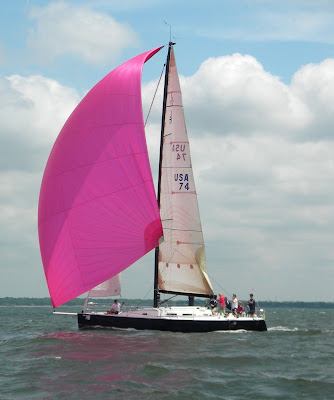
The whole sail is forward of the forestay. The halyard also needs to be forward of the forestay to jybe the sail (you don't tack a spinnaker), otherwise it will wrap under the forestay.
This is a good photo of a masthead boat flying a spinnaker:
You can see that the spinnaker is forward of the forestay at all points. The spinnaker halyard is also above and forward of the forestay.
You also asked what a fractional exit box is for. On a fractional rig boat the spinnaker halyard exits the mast (instead of the masthead) above the jib. That looks like this:
The Catalina 25 has a masthead rig, so that type of halyard exit is not appropriate.
Before you invest in expensive equipment, my suggestion would be to take advantage of some of the good, free information available on the Internet. Here are a couple of links to some basic info about setting-up and trimming a variety of sails, including asym's., and then I'd recommend you go to YouTube and search under "asymmetrical spinnaker." There are lots of articles and videos to be found (some of the videos are quite clear and helpful), and you'll quickly raise your level of understanding to the stage where you will know what you need for the type of sailing you intend to do and for the waters you intend to sail in. The people who participate in these Catalina 25/250/25 forums would be happy to help when you find a particular detail that needs clarification, and even broad questions like these might receive more attention if you post them in the General Sailing forum (I suspect that a lot of members don't even bother following threads like this one that deal with technical modifications, so you may be missing some of the very people most likely to help). Anyway, here's a start:
Notice: The advice given on this site is based upon individual or quoted experience, yours may differ. The Officers, Staff and members of this site only provide information based upon the concept that anyone utilizing this information does so at their own risk and holds harmless all contributors to this site.