Notice:
The advice given on this site is based upon individual or quoted experience, yours may differ.
The Officers, Staff and members of this site only provide information based upon the concept that anyone utilizing this information does so at their own risk and holds harmless all contributors to this site.
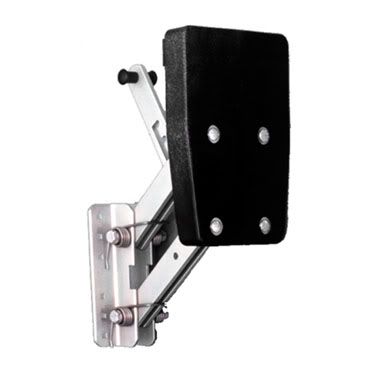
I currently have a 8HP Honda mounted on a Fulton MB1710 motor mount. According to Fulton this mount is rated for up to a 120 lb., 20 HP 2 stroke motor or a 120 lb., 5 HP 4 stroke motor. In my mind horsepower is horsepower and I cannot understand the huge discrepancy between the ratings. My Honda weighs in about 87 lbs. and seems to handle the engine well. Is their room for concern here?
Joe Wergers Utopia Fleet 7/Oceanside, CA 78 C25 FK/SR #381
I'd (independently of any ratings) judged that old mount to be inadequate for my 8hp Honda 4 stroke. (A subjective/IMHO thing)
When I took the old mount off the boat and disassembled it, the aluminum pivot bolts literally disintegrated into powder. If you decide to keep that mount, I'd remove/inspect those bolts carefully.
The MB1710 is suppose to have SS springs and fasteners though they do have fresh water models with zinc fasteners. I do value your opinion though so thanks for the reply. Obviously I wouldn't ask the question if I was totally sold on it. Any one have an idea why 4-stroke ratings are less than 2-stroke ratings.?
I, too, am a little confused about the ratings of motor mounts.
Firstly, these Fulton motor mounts, like most mounts, are not engineered to be used on a slow moving, displacement hull of a sailboat which glides relatively smoothly through the water.
No, these mounts are designed to be bolted to the transom of a high speed, wave skipping, chop pounding, fishing boat with a 200hp primary engine.
Now, I'm no engineer, but I'm fairly sure that considerably more shock loading force is exerted on the mount as the fishing boat pounds from wave to wave at 45mph (or even when trailered over bumpy roads) than the force exerted by giving the throttle to a 9.9hp on a slow moving sailboat.
<blockquote id="quote"><font size="1" face="Verdana, Arial, Helvetica" id="quote">quote:<hr height="1" noshade id="quote"><i>Originally posted by mfasis</i> <br />Might it have something to do with the fact that 4 strokes are heavier than same hp 2 strokes? <hr height="1" noshade id="quote"></blockquote id="quote"></font id="quote"> 120 lbs. are 120 lbs... I think the issue for all of the bracket makers is the thrust particularly from the new Honda and Yamaha 4-strokes with their larger, lower-pitch props. The Fulton 1710, IMHO, is likely not up to it, and could literally bend or (being aluminum) break sideways under the stress of a heavy 4-stroke putting out maximum thrust with the engine turned, as you might do when docking. I have Fulton's 1810, which is a completely different construction using wide cast U-beams, more recently used by Garelick.
The 87-lb. Honda is a somewhat different story--it has a standard prop and considerably less thrust--comparable to a 2-stroke. You're probably safe for that engine, but just barely. If you upgrade to the newer 4-stroke, you should probably upgrade the bracket, too. BTW, I saw a bent Fulton like that one on the back of an O'Day...
>-------------------------------------------------------------------------------- >The MB1710 is suppose to have SS springs and fasteners though they do have fresh water models >with zinc fasteners
The springs and fasteners on my old mount were stainless and were just fine... main pivot bolts were aluminum and that's where the problem was.
Funny thing is prior to the Honda 8 HP this mount supported a Suzuki 9.9 HP Sailmaster OB which is considerably larger than the Honda but within the limits specified by Fulton. I had the chance to use Jim Baumgarts motor mount with a similar Honda on it a few weeks ago and the increased manageability of his was very noticeable. Not sure if he has the Garhauer or the Garelick. I have to pull the engine soon to have the flywheel repaced so I will do a thorough inspection at that time. I guess it will all come down to whether the Fulton makes me nervous enough to spend the $300+ to replace it.
Four Stroke Motors develop much higher Torque and can twist an Aluminum Motor Mount or one not designed for Four Storkes...it's not so much the weight as the high Torque that is the problem.
<blockquote id="quote"><font size="1" face="Verdana, Arial, Helvetica" id="quote">quote:<hr height="1" noshade id="quote"><i>Originally posted by Dave Bristle</i> <br />...The Fulton 1710, IMHO, is likely not up to it, and could literally bend or (being aluminum) break sideways under the stress of a heavy 4-stroke putting out maximum thrust with the engine turned, as you might do when docking. I have Fulton's 1810, which is a completely different construction using wide cast U-beams...<hr height="1" noshade id="quote"></blockquote id="quote"></font id="quote">
This is where motor mount ratings puzzle me...Fulton advertises your mount, the 1810, for a 6hp 4-stroke max, which by all accounts is barely adequate to propel a C25, yet one could put a 30hp 2-stroke behemoth on that same mount without concern??? Can the 6hp develop the same "thrust" as the 30hp?
Can't figure a rational explanation either. Generally speaking, prop thrust from a 20 hp 2 stroke = Prop thrust from a 20 hp 4 stroke. Engine 'torque' shouldn't have anything to do with it as the lower unit gears the prop to turn at about the same RPM on the two engines (high-thrust designs aside).
There is a difference in 'rotational inertia' between 4 and 2 strokes... so you'd get a little more twist as you rev the engine up and down... but heck, not all that much... and outboards don't let you race the throttle anyway.
Will remain one of life's mysteries I reckon... it's the kinda thing that bugs a rational person though.
Notice: The advice given on this site is based upon individual or quoted experience, yours may differ. The Officers, Staff and members of this site only provide information based upon the concept that anyone utilizing this information does so at their own risk and holds harmless all contributors to this site.