Catalina - Capri - 25s International Assocaition Logo(2006)  
Assn Members Area · Join
Association Forum
Association Forum
Home | Profile | Register | Active Topics | Forum Users | Search | FAQ
Username:
Password:
Save Password
Forgot your Password?

 All Forums
 Catalina/Capri 25/250 Sailor's Forums
 General Sailing Forum
 Tips on sailing on headsail only?
 New Topic  Topic Locked
 Printer Friendly
Previous Page | Next Page
Author Previous Topic Topic Next Topic
Page: of 3

Stinkpotter
Master Marine Consultant

Members Avatar

Djibouti
9089 Posts

Response Posted - 09/25/2012 :  08:26:18  Show Profile
<blockquote id="quote"><font size="1" face="Verdana, Arial, Helvetica" id="quote">quote:<hr height="1" noshade id="quote"><i>Originally posted by redviking</i>...the headsail must be reefed to the proper point.<hr height="1" noshade id="quote"></font id="quote"></blockquote id="quote">...so the <i>windward</i> sheet is controlling the sail on either tack and the leeward sheet is "lazy"? Otherwise, I don't see how the geometry works. Wouldn't that "cup" the sail too much for beating to windward--unless maybe you roll it down to a handkerchief... ?

Edited by - Stinkpotter on 09/25/2012 08:28:10
Go to Top of Page

TakeFive
Master Marine Consultant

Members Avatar

2272 Posts

Response Posted - 09/25/2012 :  08:44:03  Show Profile
<blockquote id="quote"><font size="1" face="Verdana, Arial, Helvetica" id="quote">quote:<hr height="1" noshade id="quote"><i>Originally posted by Stinkpotter</i>
<br /><blockquote id="quote"><font size="1" face="Verdana, Arial, Helvetica" id="quote">quote:<hr height="1" noshade id="quote"><i>Originally posted by redviking</i>...the headsail must be reefed to the proper point.<hr height="1" noshade id="quote"></font id="quote"></blockquote id="quote">...so the <i>windward</i> sheet is controlling the sail on either tack and the leeward sheet is "lazy"? Otherwise, I don't see how the geometry works. Wouldn't that "cup" the sail too much for beating to windward--unless maybe you roll it down to a handkerchief... ?
<hr height="1" noshade id="quote"></font id="quote"></blockquote id="quote">
Well this is getting very interesting. I hadn't thought of trying to make a self-tacking jib using this trick. I do share the concern that creating a self-tacking jib by tensioning the windward sheet would cup the sail too much unless it's almost postage-stamp sized.

However, if you change your objective from headsail providing power to headsail providing a counterbalance to the main to minimize rounding up, then a heavily furled headsail starts to make sense, but only in a very heavy blow where you're at risk of severe rounding up under mainsail alone.

One interesting point - in this scenario, the C250's rig with swept back shrouds/chainplates and without forward lowers actually would reduce cupping a bit vs. the C25's rig. Maybe Sten was thinking of this, since I know how much he loves the C250's rig design. Of course, the cupping would be even less if you run the genny sheets inside the shrouds, but the conditions under which you'd want to do this might not be particularly conducive to going forward to the foredeck. You'd probably have to anticipate the conditions and re-rig before leaving the dock.

Edited by - TakeFive on 09/25/2012 08:46:02
Go to Top of Page

Steve Milby
Past Commodore

Members Avatar

USA
5909 Posts

Response Posted - 09/25/2012 :  08:58:23  Show Profile
I'm still just thinking out loud.

If you hardened both jib sheets to flatten the jib, and then tacked, that would help the boat get across the eye of the wind. Afterward, you <u>could</u> adjust the tension on the new working jibsheet a little bit, to get the best sail shape, but then you would have to equalize the tension on both jib sheets before the next tack. Equalizing the tension on both jib sheets seems to be what makes the jib, to some extent, self-tending.

On the other hand, after experimenting with the idea, you might find that it isn't necessary to adjust the jib sheet to get enough sail shape to achieve the purpose.

Edited by - Steve Milby on 09/25/2012 09:03:24
Go to Top of Page

redeye
Master Marine Consultant

Members Avatar

3477 Posts

Response Posted - 09/25/2012 :  10:06:22  Show Profile
Gravy?? Did somebody say Gravy??

Anyhoo... go look at an airplane wing. Think of Creating a lift forward not up. The wings are level to the direction the wind goes over them to create lift, not blowing from below to lift them.

A boat is not a plane but the point is many are setting their sails to create excessive heel, and weather helm. The main is usually much too tight, with a closed leech.

The main creates a lot of forward motion.

Try this.. tighten up your topping lift, open up the leach, let out the boom and tighten in the jib. Imagine the wind running across the main undisturbed.

The leach has such power to change the direction of the boat, to turn it up to windward.

As the boat turns up to windward, the jib luffs and the boat will fall off and correct itself. As it falls off too far the main will create pressure on the leach and correct back up into the wind.

The boat becomes self steering and when the wind blows hard converts the blow into forward motion rather than heel.

My Girlfriend freaks out when I set this and says "God" is steering the boat ( as he is )

Your forward power is in the curve in the front of the mainsail. Also look at a windsurfing board.. they are going so fast, with -no- heel.

Gravy Man....Gravy.

Edited by - on
Go to Top of Page

Stinkpotter
Master Marine Consultant

Members Avatar

Djibouti
9089 Posts

Response Posted - 09/25/2012 :  10:26:07  Show Profile
<blockquote id="quote"><font size="1" face="Verdana, Arial, Helvetica" id="quote">quote:<hr height="1" noshade id="quote"><i>Originally posted by Steve Milby</i>
<br />...If you hardened both jib sheets to flatten the jib, and then tacked, that would help the boat get across the eye of the wind. Afterward, you <u>could</u> adjust the tension on the new working jibsheet a little bit, to get the best sail shape, but then you would have to <b>equalize the tension on both jib sheets before the next tack</b>. Equalizing the tension on both jib sheets seems to be what makes the jib, to some extent, self-tending...
<hr height="1" noshade id="quote"></font id="quote"></blockquote id="quote">Also thinking... (trying to picture...) Equalizing the tension of both sheets on one tack will create unequal tension on the other tack, unless you have the clew centered over the deck. I'm still waiting to hear whether Sten means the windward sheet to be the "working" sheet while the leeward sheet goes slack after each tack--that's the only way I can see the setup being "self-tending", but would seem to create a shape issue--maybe less so further up the sail...

On a C-25, the windward jib sheet would be bending around the forward lower shroud, making a pretty adverse lead angle to the jib clew on the other side.

Edited by - Stinkpotter on 09/25/2012 10:33:28
Go to Top of Page

Steve Milby
Past Commodore

Members Avatar

USA
5909 Posts

Response Posted - 09/25/2012 :  11:43:38  Show Profile
<blockquote id="quote"><font size="1" face="Verdana, Arial, Helvetica" id="quote">quote:<hr height="1" noshade id="quote"><i>Originally posted by Stinkpotter</i>
<br />On a C-25, the windward jib sheet would be bending around the forward lower shroud, making a pretty adverse lead angle to the jib clew on the other side.
<hr height="1" noshade id="quote"></font id="quote"></blockquote id="quote">
That's why I think the sheets might have to be led inside the stays. That would enable you to create a flatter, better-shaped jib, with much less slack in the sheets.

Edited by - on
Go to Top of Page

PCP777
Master Marine Consultant

Members Avatar

USA
1225 Posts

Response Posted - 09/25/2012 :  14:26:04  Show Profile
A few weeks ago, as a lark, we raced the C-27 head sail only, ON A DOWNWIND START!!!! Believe it or not, we didn't finish DFL, we actually beat a C-30!!! Out of four boats we came in third. Anyways, I sail head sail alone often. Is that because I suck at sailing? No. If I am with the wife and kids and just want to do some wine and cheese sailing and not have to F with the main cover and flaking etc, I just run head sail only. No shame in that game. I also do the same thing when I am unsure of the conditions outside of the marina. I might be cautious and use head sail and then determine if I want to raise the main. As far as the over steer? I Try slow tacking the helm instead of jamming her over to lee. Don't just slam it hard over and be ready for the reaction and you can help mitigate it. I run a 135.

Oh, maybe a coincidence, but that same C-30 appeared on CL that very night.

Edited by - PCP777 on 09/25/2012 14:26:46
Go to Top of Page

Dave5041
Former Mainsheet Editor

Members Avatar

USA
3758 Posts

Response Posted - 09/25/2012 :  14:56:42  Show Profile
Back to self tailing: If you put a block on the clew and put the genoa cars at the forward shrouds, you could secure a line to one g. block. pass it through the clew block, the other g. block and aft. Marginal, but it might be tolerable over limited range with the clew forward of the shrouds..

Edited by - on
Go to Top of Page

Stinkpotter
Master Marine Consultant

Members Avatar

Djibouti
9089 Posts

Response Posted - 09/25/2012 :  20:00:42  Show Profile
<blockquote id="quote"><font size="1" face="Verdana, Arial, Helvetica" id="quote">quote:<hr height="1" noshade id="quote"><i>Originally posted by Dave5041</i>
<br />Back to self tailing: If you put a block on the clew and put the genoa cars at the forward shrouds, you could secure a line to one g. block. pass it through the clew block, the other g. block and aft. Marginal, but it might be tolerable over limited range with the clew forward of the shrouds..<hr height="1" noshade id="quote"></font id="quote"></blockquote id="quote">That's actually a version of a not-too-uncommon self-tending jib set-up for small daysailers with small, fractionally-rigged jibs. But it's a "special rig" instead of a tactical use of the normal rig on a C-25. Leading sheets inside the shrouds (and over the cabin-top to the clew on the opposite side?) also doesn't seem like something I'd want to do as a quick heavy-weather tactic.

I'm still curious about Sten's tactic--whether the windward sheet is the working sheet--I'm assuming it is. Sten???

Edited by - Stinkpotter on 09/25/2012 20:01:55
Go to Top of Page

TakeFive
Master Marine Consultant

Members Avatar

2272 Posts

Response Posted - 09/25/2012 :  20:27:14  Show Profile
<blockquote id="quote"><font size="1" face="Verdana, Arial, Helvetica" id="quote">quote:<hr height="1" noshade id="quote"><i>Originally posted by Stinkpotter</i>
<br /><blockquote id="quote"><font size="1" face="Verdana, Arial, Helvetica" id="quote">quote:<hr height="1" noshade id="quote"><i>Originally posted by Dave5041</i>
<br />Back to self tailing: If you put a block on the clew and put the genoa cars at the forward shrouds, you could secure a line to one g. block. pass it through the clew block, the other g. block and aft. Marginal, but it might be tolerable over limited range with the clew forward of the shrouds..<hr height="1" noshade id="quote"></font id="quote"></blockquote id="quote">That's actually a version of a not-too-uncommon self-tending jib set-up for small daysailers with small, fractionally-rigged jibs. But it's a "special rig" instead of a tactical use of the normal rig on a C-25. Leading sheets inside the shrouds (and over the cabin-top to the clew on the opposite side?) also doesn't seem like something I'd want to do as a quick heavy-weather tactic.

I'm still curious about Sten's tactic--whether the windward sheet is the working sheet--I'm assuming it is. Sten???
<hr height="1" noshade id="quote"></font id="quote"></blockquote id="quote">
I already have a loop through my clew for a whisker pole. I attach the whisker pole this way so I can jibe without going forward by adjusting the pole just short enough that it does not collide with the forestay.

So on the C250 I could run a jackline from the port bail at the base of the stantion (commonly used for the "baby stays"), in front of the mast, and to the starboard bail. I should leave a block on this jackline, with a lightweight snap shackle on it. Whenever I want a self-tending jib, I could attach the block/snap shackle to the loop in the clew. Then just loosen both the sheets enough to allow them to flop around freely and let the jackline to take over the tension. Hopefully the sheets don't need so much slack that they dangle in the water (I'll have to test that out).

Once again, on the C250, the lack of forward lowers makes this much more feasible. And I could then unfurl my 110 out to 90 or 100% with minimal compromise in sail shape.

I'm not sure this is a good heavy weather solution, but if my wife wants to take a nap in the cockpit it would provide a way to tack without me waking her up to operate the cabintop winches.

Hmmm, something to think about. Have any other C250 owners tried this?

Edited by - TakeFive on 09/25/2012 20:28:10
Go to Top of Page

Stinkpotter
Master Marine Consultant

Members Avatar

Djibouti
9089 Posts

Response Posted - 09/26/2012 :  06:55:05  Show Profile
<blockquote id="quote"><font size="1" face="Verdana, Arial, Helvetica" id="quote">quote:<hr height="1" noshade id="quote"><i>Originally posted by TakeFive</i>
<br />...So on the C250 I could run a jackline from the port bail at the base of the stantion (commonly used for the "baby stays"), in front of the mast, and to the starboard bail. I should leave a block on this jackline, with a lightweight snap shackle on it. Whenever I want a self-tending jib, I could attach the block/snap shackle to the loop in the clew.<hr height="1" noshade id="quote"></font id="quote"></blockquote id="quote">Instead of fixing the line to both bails, I'd suggest a block on one of them, with the line led through it and back to a cleat at the cockpit (as the other Dave describes). This allows you to adjust the self-tending sheet to the size of your reefed jib and your point of sail.

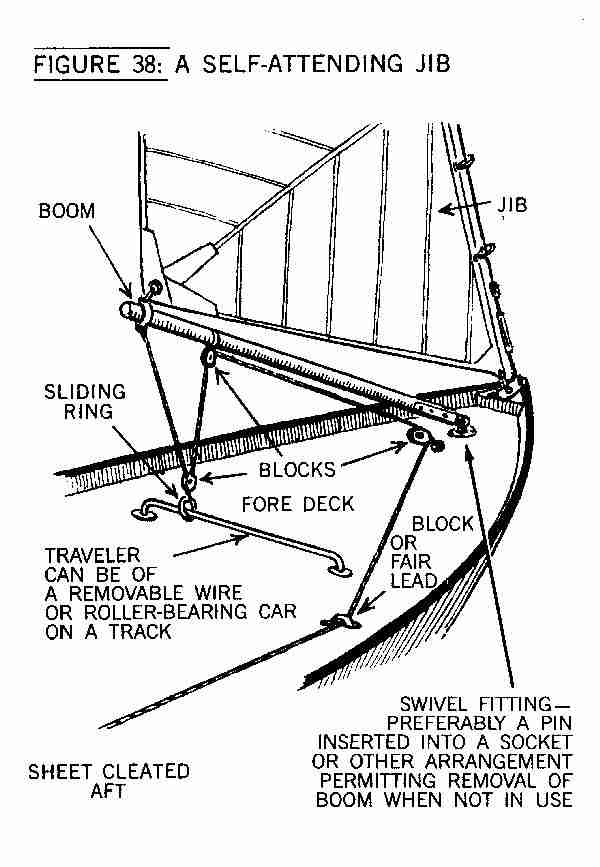
I doubt that 100% will work well--the sheeting angle will probably be too vertical so the sail will be extremely full for going to weather. You'll probably find it needs to be smaller. This is why most self-tending rigs have "club foot" booms (or Hoyt booms)--so sail shape is maintained with a vertical sheet.

Edited by - on
Go to Top of Page

redviking
Master Marine Consultant

Members Avatar

USA
1771 Posts

Response Posted - 09/26/2012 :  16:38:06  Show Profile
<blockquote id="quote"><font size="1" face="Verdana, Arial, Helvetica" id="quote">quote:<hr height="1" noshade id="quote"><i>Originally posted by Steve Milby</i>
Did you figure that out yourself, Sten, or did you learn it from some olde salt that you ran into in your travels?
<hr height="1" noshade id="quote"></font id="quote"></blockquote id="quote">

Well, sorta... Was offshore heading somewhere and I picked up some radio chatter from a couple of other cruisers heading south I think, so we were tacking. I listened in as one cruiser described his nightwatch rig and how it allowed his wife and crew to sleep without the grinding of winches.

So I tried it out the next day and it works. Windward or leeward sheet, adjust as you wish. The key is that the sail clears the babystay or other rigging. Some of the sail area is up too high, but the ease of use makes that hardly a worry. I've used this technique as a means of pacing back and forth before entering an unfamiliar port at dawn. Also great for guests.

sten

Edited by - on
Go to Top of Page

TakeFive
Master Marine Consultant

Members Avatar

2272 Posts

Response Posted - 09/26/2012 :  18:28:15  Show Profile
<blockquote id="quote"><font size="1" face="Verdana, Arial, Helvetica" id="quote">quote:<hr height="1" noshade id="quote"><i>Originally posted by Stinkpotter</i>
<br />Instead of fixing the line to both bails, I'd suggest a block on one of them, with the line led through it and back to a cleat at the cockpit (as the other Dave describes). This allows you to adjust the self-tending sheet to the size of your reefed jib and your point of sail.

I doubt that 100% will work well--the sheeting angle will probably be too vertical so the sail will be extremely full for going to weather. You'll probably find it needs to be smaller. This is why most self-tending rigs have "club foot" booms (or Hoyt booms)--so sail shape is maintained with a vertical sheet.
<hr height="1" noshade id="quote"></font id="quote"></blockquote id="quote">
I like those ideas, and I can envision how they would help.

As for the Hoyt Jib Boom, would it be possible to simulate some of its effect and gain some improved sail shape by attaching the whisker pole to the tack and clew, effectively creating a small boom? I can imagine that's a pretty strong compressive buckling force on my medium weight pole, so I might reinforce it with a larger PVC pipe sleeved around it. It would not have all of the benefits of the Hoyt device, but might the some improved sail shape up to around 90%.

Of course, all this gets pretty cumbersome to rig, but for easy single-handing while the crew sleeps it might be worth a try.

Edited by - TakeFive on 09/26/2012 18:30:20
Go to Top of Page

Stinkpotter
Master Marine Consultant

Members Avatar

Djibouti
9089 Posts

Response Posted - 09/26/2012 :  21:35:37  Show Profile
<blockquote id="quote"><font size="1" face="Verdana, Arial, Helvetica" id="quote">quote:<hr height="1" noshade id="quote"><i>Originally posted by redviking</i>
<br />...Windward or leeward sheet, adjust as you wish...<hr height="1" noshade id="quote"></font id="quote"></blockquote id="quote">Come on Sten! If you're setting both sheets so you can leave them with no changes as you tack, it's gotta be the windward sheet (to a pretty small piece of sail). I don't see how the geometry can't work the other way. If you can't confirm that, it never happened. I haven't tried this, but that's my story and I'm sticking to it.
Edited by - on
Go to Top of Page

redviking
Master Marine Consultant

Members Avatar

USA
1771 Posts

Response Posted - 09/26/2012 :  22:53:56  Show Profile
<blockquote id="quote"><font size="1" face="Verdana, Arial, Helvetica" id="quote">quote:<hr height="1" noshade id="quote"><i>Originally posted by Stinkpotter</i>
<br /><blockquote id="quote"><font size="1" face="Verdana, Arial, Helvetica" id="quote">quote:<hr height="1" noshade id="quote"><i>Originally posted by redviking</i>
<br />...Windward or leeward sheet, adjust as you wish...<hr height="1" noshade id="quote"></font id="quote"></blockquote id="quote">Come on Sten! If you're setting both sheets so you can leave them with no changes as you tack, it's gotta be the windward sheet (to a pretty small piece of sail). I don't see how the geometry can't work the other way. If you can't confirm that, it never happened. I haven't tried this, but that's my story and I'm sticking to it.
<hr height="1" noshade id="quote"></font id="quote"></blockquote id="quote">

Oh, geez... Leeward sheet works too. Just think of it this way before I get the arts and crafts put and make scale drawings. Wind over the port side, leeward jib sheet on reefed jib cleated with ample slack left of the port side. What happens when you tack? The wind comes over the starboard side and the leeward port jib sheet tqkes over.

Now, you can reef the jib until both sheets are tight and that will sorta work. You can use the windward sheet,you can do a bunch of stuff. What you don't have to do is tack normally. The jib is restricted in movement by both sheets. After the tack, you could adjust them for sail shape, but you won't have to grind the winches. C'Mon I figured this one would be easy for you.

It does not replace trimming, but I have found that it works quite well and will work on other boats too. I may have found the next 250 dreamboat setup.

If you us the windward sheet, you will get a lot of cup, depends on how far out you let the jib go. Sometimes that will work. But the idea is that the sail is limited in travel and will go from side to side without hanging on rigging.

Paper and markers standing by.

Sten out...

Edited by - on
Go to Top of Page

TakeFive
Master Marine Consultant

Members Avatar

2272 Posts

Response Posted - 09/27/2012 :  04:10:02  Show Profile
<blockquote id="quote"><font size="1" face="Verdana, Arial, Helvetica" id="quote">quote:<hr height="1" noshade id="quote"><i>Originally posted by redviking</i>
<br />
Oh, geez... Leeward sheet works too. Just think of it this way before I get the arts and crafts put and make scale drawings. Wind over the port side, leeward jib sheet on reefed jib cleated with ample slack left of the port side. What happens when you tack? The wind comes over the starboard side and the leeward port jib sheet tqkes over.

Now, you can reef the jib until both sheets are tight and that will sorta work. You can use the windward sheet,you can do a bunch of stuff. What you don't have to do is tack normally. The jib is restricted in movement by both sheets. After the tack, you could adjust them for sail shape, but you won't have to grind the winches. C'Mon I figured this one would be easy for you.

It does not replace trimming, but I have found that it works quite well and will work on other boats too. I may have found the next 250 dreamboat setup.

If you us the windward sheet, you will get a lot of cup, depends on how far out you let the jib go. Sometimes that will work. But the idea is that the sail is limited in travel and will go from side to side without hanging on rigging.

Paper and markers standing by.

Sten out...
<hr height="1" noshade id="quote"></font id="quote"></blockquote id="quote">
Sorry, IMO if you need to trim on every tack, then it is not self tacking as originally described.

Edited by - on
Go to Top of Page

redviking
Master Marine Consultant

Members Avatar

USA
1771 Posts

Response Posted - 09/27/2012 :  05:38:27  Show Profile
Once you get it set, I.e. you have tacked once and both sides are even and working properly, then it is self tacking. No different than how a Hoyt boom works.

Sten

Edited by - on
Go to Top of Page

Stinkpotter
Master Marine Consultant

Members Avatar

Djibouti
9089 Posts

Response Posted - 09/27/2012 :  06:04:44  Show Profile
<blockquote id="quote"><font size="1" face="Verdana, Arial, Helvetica" id="quote">quote:<hr height="1" noshade id="quote"><i>Originally posted by redviking</i>
<br />...Just think of it this way before I get the arts and crafts put and make scale drawings. Wind over the port side, leeward jib sheet on reefed jib cleated with ample slack left of the port side. What happens when you tack? The wind comes over the starboard side and the leeward port jib sheet tqkes over...<hr height="1" noshade id="quote"></font id="quote"></blockquote id="quote">You need to try your scale drawing, leaving each sheet length unchanged.

Without pictures, here's how I see it: On port tack, the working sheet is normally starboard (leeward). Even if you tension the port sheet so it is not slack, then when you tack, the starboard sheet is still shorter and the port sheet longer--the starboard sheet will hold the jib and the port sheet will go slack.

If, however, you center the reefed sail and set both sheets at the same length, slightly slack, then on either tack, the clew will go to leeward and be held by the windward sheet--the leeward sheet will go slack. You probably need to do this with a relatively small jib--rolled down or whatever--so the angle of the windward sheet doesn't cup it back too much. That, incidentally, is closer to how a Hoyt boom works, except the boom prevents the cupping.

Edited by - Stinkpotter on 09/27/2012 06:05:51
Go to Top of Page

TakeFive
Master Marine Consultant

Members Avatar

2272 Posts

Response Posted - 09/27/2012 :  06:06:55  Show Profile
Sorry, it seems like you are saying contradictory things.

First you say you need to have ample slack on the windward side before you tack, and you have to trim each tack:
<blockquote id="quote"><font size="1" face="Verdana, Arial, Helvetica" id="quote">quote:<hr height="1" noshade id="quote"><i>Originally posted by redviking</i>
<br />Wind over the port side, leeward jib sheet on reefed jib cleated with ample slack left of the port side. What happens when you tack? The wind comes over the starboard side and the leeward port jib sheet tqkes over...It does not replace trimming...If you us the windward sheet, you will get a lot of cup<hr height="1" noshade id="quote"></font id="quote"></blockquote id="quote">
Then you say both sides are even:
<blockquote id="quote"><font size="1" face="Verdana, Arial, Helvetica" id="quote">quote:<hr height="1" noshade id="quote"><i>Originally posted by redviking</i>
<br />Once you get it set, I.e. you have tacked once and both sides are even and working properly, then it is self tacking.
<hr height="1" noshade id="quote"></font id="quote"></blockquote id="quote">
Sorry, if both sheets are the same length, then the windward sheet is always going to be the one controlling the jib (and causing cupping).
<blockquote id="quote"><font size="1" face="Verdana, Arial, Helvetica" id="quote">quote:<hr height="1" noshade id="quote"><i>Originally posted by redviking</i>
<br />No different than how a Hoyt boom works.<hr height="1" noshade id="quote"></font id="quote"></blockquote id="quote">
I see a lot of difference. The Hoyt boom prevents cupping and backwinding by maintaining some tension in the foot even though the windward sheet is under tension.

Maybe I'm just dense, but I have a feeling that I'm not the only one who sees some issues with this.
<blockquote id="quote"><font size="1" face="Verdana, Arial, Helvetica" id="quote">quote:<hr height="1" noshade id="quote"><i>Originally posted by redviking</i>
<br />I may have found the next 250 dreamboat setup...the sail is limited in travel and will go from side to side without hanging on rigging.<hr height="1" noshade id="quote"></font id="quote"></blockquote id="quote">
My headsail crosses over just fine without doing this stuff, and has never gotten hung up on rigging. We don't need any help with that. What got my interest was your statement that this was a self-tacking setup, which it apparently is not (unless you have a boom on the headsail).

Back to my idea about using a whisker pole to tension the foot of the headsail, has anyone tried that before? I can think of one possible hazard (aside from the pole breaking and holing your sail and anybody nearby) - with the pole attached to the tack, you cannot furl the headsail without first going forward to detach the pole. This would preclude you from doing this in heavy weather conditions. But for normal sailing, it might be feasible.

I realize that this thread has morphed from sailing on headsail alone in heavy weather, to self-tacking rigs in general conditions.

Edited by - TakeFive on 09/27/2012 06:10:01
Go to Top of Page

Steve Milby
Past Commodore

Members Avatar

USA
5909 Posts

Response Posted - 09/27/2012 :  07:32:06  Show Profile
<blockquote id="quote"><font size="1" face="Verdana, Arial, Helvetica" id="quote">quote:<hr height="1" noshade id="quote"><i>Originally posted by TakeFive</i>
<br />[quote]<i>Originally posted by redviking</i>
<br />
Sorry, IMO if you need to trim on every tack, then it is not self tacking as originally described.
<hr height="1" noshade id="quote"></font id="quote"></blockquote id="quote">Self-tacking doesn't mean it's self-trimming. It just means you don't have to haul in yards of jibsheet every time you tack.

I think we need to experiment with the idea before we can fairly conclude that it won't work. Sten isn't saying this is the perfect, most efficient way of sailing the boat to windward. He's just saying it can be done, and it's a useful technique, especially for a shorthander and especially in heavy weather.

Suppose you trim both jibsheets equally, and trim the jib flat, down the centerline of the boat. When you tack and fall off onto a closehauled course, the sail will, in effect, be overtrimmed, but it will still help drive the boat somewhat, and it will still provide some balance to the sailplan. If you ease both jibsheets slightly, the jib will have a little more depth in its draft, but, depending on how much you ease the sheets, that's a good thing. It will make the jib a bit more powerful.

Think about it this way. Even when you heave to, with the jib over on the opposite side, the boat still makes slow speed to windward. I can certainly see the possibility that, if you get the jibsheets trimmed correctly, this could provide adequate performance to let one crew rest while the other is able to singlehandedly tack back and forth without having to grind the winches.

The question isn't whether this will provide optimum performance. The question is whether it will provide adequate performance to be a useful technique to keep in your bag of sailing tricks. I think we should experiment with it before we pass judgment on it.

Edited by - on
Go to Top of Page

redviking
Master Marine Consultant

Members Avatar

USA
1771 Posts

Response Posted - 09/27/2012 :  07:36:55  Show Profile
If you have more than a scrap out, i.e., the headsail barely reaches the babystay, then both sheets are taut and the sail is essentially centered. Let's start there. We can all see that happening, right?

OK, tacking by itself - little to no sail movement. - Foam luffs are important for a furling headsail to have some shape. That's truly self tacking.

Now ease off a bit to allow for more travel. Sail will only move so far before the windward sheet grabs it. Still self tacking as long as it clears the babystay.

Running lines inside is a good idea. My standing is all pretty narrow.

All of my observations were on a C&C 39, not my beloved C25. Your results may vary.

In terms of expanding the realm of solo sailors, I believe even if some minor sheet adjustments should be made after each tack, this technique takes the pressure off. Even in not fully self tacking mode, i.e. you let out more of the jib or genny, the headsail is still controlled by the windward sheet until you get around to transferring the load to the leeward sheet. No drama, no mad dives. A slightly backwinded headsail helps the transfer. Again, this is a modification of the complete hands off approach.

I've seen many cruising boats with jib tracks since then. No boom visible although I do believe that there is a precedent for the spin pole mod Take Five describes. My problem is that with a furler, a reefed headsail still has the sail area way too high for the track or the spin pole/boom. Typically those with the selftacking jib tracks are running storm jibs which are cut really low.

play with it. Similar setup with the headsail might be applicable in a storm hove to situation.

sten


Edited by - redviking on 09/27/2012 07:45:46
Go to Top of Page

Steve Milby
Past Commodore

Members Avatar

USA
5909 Posts

Response Posted - 09/27/2012 :  07:55:21  Show Profile
<blockquote id="quote"><font size="1" face="Verdana, Arial, Helvetica" id="quote">quote:<hr height="1" noshade id="quote"><i>Originally posted by TakeFive</i>
<br />
My headsail crosses over just fine without doing this stuff, and has never gotten hung up on rigging. We don't need any help with that. What got my interest was your statement that this was a self-tacking setup, which it apparently is not (unless you have a boom on the headsail).<hr height="1" noshade id="quote"></font id="quote"></blockquote id="quote">
I have been beating to windward, singlehanding on the Bay, in 25 kts against heavy chop, and struggled to tack the boat alone, releasing the working jibsheet at just the right moment, only to have a wave stop the boat and prevent it from crossing the eye of the wind. Or, if I did manage to get it across to the new tack, the boat was driving off abeam or even to leeward before I could grind the jib down enough to bring it back to a closehauled course. Bear in mind that, while I'm trying to haul in the jibsheet, I still have to reach over as needed and try to steer the boat from the wrong side of the steering pedestal. It's extremely difficult. If you can get the boat to cross the eye of the wind in a blow without releasing the working sheet and without hard grinding and without leaving the helm unattended, that would be a hugely useful technique.

We're all asking the same questions about it, but you can't always answer all your questions by visualization. Sometimes you just need to try it in the conditions for which it is recommended.

Edited by - on
Go to Top of Page

redviking
Master Marine Consultant

Members Avatar

USA
1771 Posts

Response Posted - 09/27/2012 :  08:14:40  Show Profile
<blockquote id="quote"><font size="1" face="Verdana, Arial, Helvetica" id="quote">quote:<hr height="1" noshade id="quote"><i>Originally posted by Steve Milby</i>
<br /><blockquote id="quote"><font size="1" face="Verdana, Arial, Helvetica" id="quote">quote:<hr height="1" noshade id="quote"><i>Originally posted by TakeFive</i>
<br />
My headsail crosses over just fine without doing this stuff, and has never gotten hung up on rigging. We don't need any help with that. What got my interest was your statement that this was a self-tacking setup, which it apparently is not (unless you have a boom on the headsail).<hr height="1" noshade id="quote"></font id="quote"></blockquote id="quote">
If you can get the boat to cross the eye of the wind in a blow without releasing the working sheet and without hard grinding and without leaving the helm unattended, that would be a hugely useful technique.<hr height="1" noshade id="quote"></font id="quote"></blockquote id="quote">

When I singlehand, I will turn auto off, manually tack to my new course, engage auto and start trimming the leeward sheet before releasing the windward sheet. Pretty painless that way.

sten

Edited by - on
Go to Top of Page

Steve Milby
Past Commodore

Members Avatar

USA
5909 Posts

Response Posted - 09/27/2012 :  08:42:19  Show Profile
<blockquote id="quote"><font size="1" face="Verdana, Arial, Helvetica" id="quote">quote:<hr height="1" noshade id="quote"><i>Originally posted by redviking</i>
<br />[quote]When I singlehand, I will turn auto off, manually tack to my new course, engage auto and start trimming the leeward sheet before releasing the windward sheet. Pretty painless that way.

sten
<hr height="1" noshade id="quote"></font id="quote"></blockquote id="quote">Yeah, that would be the way to do it, but I don't trust my old AP to hold a course in rough weather. It's very slow to react. I need a new AP. Maybe I'll put it in my budget for 2019.

Edited by - Steve Milby on 09/27/2012 08:43:57
Go to Top of Page

TakeFive
Master Marine Consultant

Members Avatar

2272 Posts

Response Posted - 09/27/2012 :  08:58:59  Show Profile
<blockquote id="quote"><font size="1" face="Verdana, Arial, Helvetica" id="quote">quote:<hr height="1" noshade id="quote"><i>Originally posted by Steve Milby</i>
<br />Yeah, that would be the way to do it, but I don't trust my old AP to hold a course in rough weather. It's very slow to react. I need a new AP. Maybe I'll put it in my budget for 2019.
<hr height="1" noshade id="quote"></font id="quote"></blockquote id="quote">
I'm guilty of another hijack here, but most APs have parameters that you can tune to increase sensitivity in rough weather. There are tradeoffs to this, because they can go unstable in calm weather (oscillating course where the oscillations grow). I was able to set my Raymarine ST4000+ to display the tuning parameters on the screen, enabling me to adjust them on the fly. I use a very low gain in mild weather, but increase it in rougher weather. There are other parameters as well, but I generally don't need to mess with them when the weather changes.

Sometimes weather is so rough that no settings will help the AP. AP's can only do feedback loops - your eyes look ahead and do feed-forward, which is better than any AP can do.

Edited by - TakeFive on 09/27/2012 10:19:29
Go to Top of Page
Page: of 3 Previous Topic Topic Next Topic  
Previous Page | Next Page
 New Topic  Topic Locked
 Printer Friendly
Jump To:
Association Forum © since 1999 Catalina Capri 25s International Association Go To Top Of Page
Powered By: Snitz Forums 2000 Version 3.4.06
Notice: The advice given on this site is based upon individual or quoted experience, yours may differ.
The Officers, Staff and members of this site only provide information based upon the concept that anyone utilizing this information does so at their own risk and holds harmless all contributors to this site.



